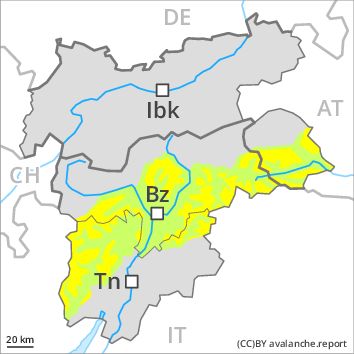
Regions
Val Müstair Alps, Langtaufers, Schnals Ridge, Silvretta, Southern Stubai Alps, Samnaun Mountains, Southern Zillertal Alps and High Tauern, Northern Oetz and Stubai Alps, Saldurn-Mastaun Ridge, Western Tuxer Alps, Texel Mountains, Eastern Tuxer Alps, Western Kitzbühel Alps, Western Pfunderer Mountains, Eastern Kitzbühel Alps, Glockturm Range, Eastern Pfunderer Mountains, Durreck Range, Weißkugel Range, Western Rieserferner Mountains, Gurgler Range, Central Stubai Alps, Ortler Range, Eastern Rieserferner Mountains, Glockner Range, Brandenberg Alps, Wilder Kaiser Mountains - Waidring Alps, Grieskogel Mountains
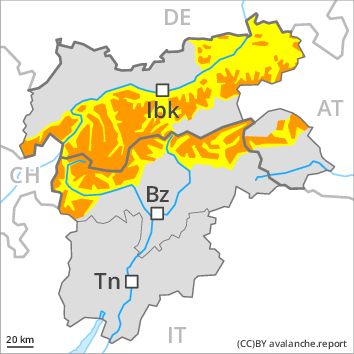
Danger level
Avalanche Problem
Wind-drifted snow above 1600m, N-NE-E-SE-S-SW-W-NW

The backcountry and freeriding conditions are critical. Fresh and older wind slabs represent the main danger.
As a consequence of fresh snow and a storm force to violent wind, extensive wind slabs formed in the last two days especially in gullies and bowls and behind abrupt changes in the terrain. Especially in places where the wind is storm force the avalanche danger is greater. The brittle wind slabs will be covered with fresh snow in some cases and therefore difficult to recognise. They will increase with altitude. Even single winter sport participants can release avalanches in many places, including dangerously large ones. As a consequence of warming during the day, the likelihood of dry slab avalanches being released will increase.
As a consequence of solar radiation individual natural loose snow slides are possible. This applies in particular on extremely steep sunny slopes.
Snowpack
dp 6: cold, loose snow and wind
dp 9: graupel blanketed with snow
The fresh snow of the last two days has bonded well with the old snowpack. Since Tuesday extensive wind slabs formed in particular above approximately 1600 m. The various wind slabs have bonded poorly together. The old snowpack will be wet all the way through below approximately 2300 m.
Tendency
The backcountry and freeriding conditions remain critical.