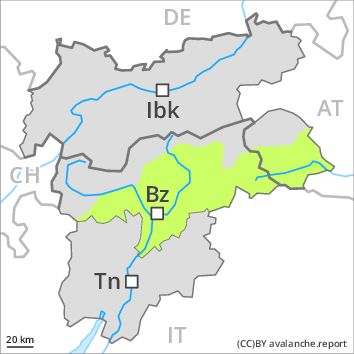
Regions
Durreck Range, Western Rieserferner Mountains, Val Müstair Alps, Langtaufers, Ortler Range, Schnals Ridge, Southern Stubai Alps, Venediger Range, Southern Zillertal Alps and High Tauern, Eastern Rieserferner Mountains, Saldurn-Mastaun Ridge, Glockner Range, Texel Mountains
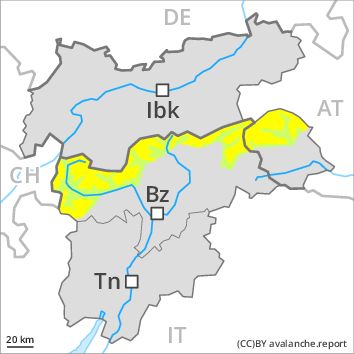
Danger level
Avalanche Problem
Wind-drifted snow above 2200m, N-NE-E-SE-S-NW

Fresh wind slabs require caution.
Fresh and somewhat older wind slabs can be released by a single winter sport participant in some cases in particular on northwest to north to south facing aspects above approximately 2200 m. In some cases avalanches are medium-sized. These avalanche prone locations are clearly recognisable to the trained eye.
Weakly bonded old snow: In very isolated cases avalanches can be released in the old snowpack and reach dangerously large size in particular on very steep shady slopes. Caution is to be exercised in particular at transitions from a shallow to a deep snowpack in little used backcountry terrain, in isolated cases also in areas close to the tree line.
As a consequence of warming during the day, the likelihood of dry and moist snow slides being released will increase a little on rocky sunny slopes.
Snowpack
dp 6: cold, loose snow and wind
As the day progresses mostly small wind slabs will form in particular in gullies and bowls and behind abrupt changes in the terrain. Faceted weak layers exist in the old snowpack. The snowpack will be subject to considerable local variations. On south and southwest facing slopes a little snow is lying at low and intermediate altitudes. In steep terrain there is a danger of falling on the hard snow surface.
Tendency
The backcountry touring conditions are generally favourable.