Regions
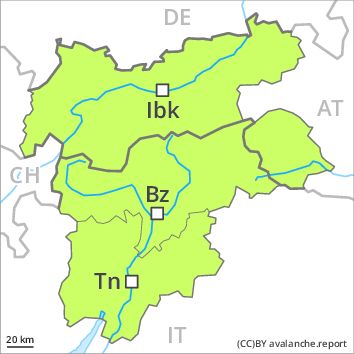
Sexten Dolomites, Latemar, Southern Adamello, Adamello - Presanella, Northern Brenta - Peller, Bondone and Stivo, Folgaria - Laverone, Southern Brenta, Southern Lagorai, Northern Lagorai, Allgäu Alps, Eastern Lechtal Alps - Ammergau Alps, Mieming Mountains, Karwendel Mountains, Brandenberg Alps, Wilder Kaiser Mountains - Waidring Alps, Western Lechtal Alps, Central Lechtal Alps, Grieskogel Mountains, Val Müstair Alps, Western Verwall Mountains, Langtaufers, Eastern Verwall Mountains, Schnals Ridge, Silvretta, Southern Stubai Alps, Samnaun Mountains, Southern Zillertal Alps and High Tauern, Northern Oetz and Stubai Alps, Saldurn-Mastaun Ridge, Western Tuxer Alps, Texel Mountains, Eastern Tuxer Alps, Sarntal Alps, Western Kitzbühel Alps, Western Pfunderer Mountains, Eastern Kitzbühel Alps, Glockturm Range, Maddalene, Pine' - Mocheni Valley, Eastern Pfunderer Mountains, Durreck Range, Weißkugel Range, Western Rieserferner Mountains, Gurgler Range, Western Deferegger Alps, Central Stubai Alps, Ortler Range, Northern Zillertal Alps, Ulten Valley, Venediger Range, Eastern Nonsberger Alps, Eastern Rieserferner Mountains, Northern Dolomites of Fiemme, Glockner Range, Gröden Dolomites, Primiero - Pale di S. Martino, Eastern Deferegger Alps, Prags Dolomites, Prealps, Schober Mountains, Cembra Valley, Lienzer Dolomites, Vallarsa, Western Nonsberg Alps, Fassa Valley, Sole, Pejo and Rabbi, Ledro Valley, Paganella, Marzola - Valsugana
Danger level
Avalanche Problem
Wind-drifted snow above 2400m, N-NE-NW

A generally favourable avalanche situation will prevail. Fresh wind slabs require caution.
The Avalanche Warning Service currently has only a small amount of information that has been collected in the field.
As a consequence of a sometimes strong northerly wind, rather small wind slabs formed in places that are protected from the wind. This applies in particular at high altitudes and in high Alpine regions. The avalanches are rather small and can mostly be released by large loads.
Intermediate altitudes: As a consequence of warming during the day and solar radiation there will be only a slight increase in the danger of gliding avalanches and moist snow slides, in particular on steep sunny slopes.
Snowpack
dp 6: cold, loose snow and wind
As a consequence of the strong wind the wind slabs have increased in size moderately. These are lying on soft layers in particular on steep shady slopes. The wind slabs are lying on a crust on east to south to west facing aspects. The surface of the snowpack will freeze to form a strong crust and will hardly soften at all. In very isolated cases weak layers exist in the old snowpack, in particular on steep, little used shady slopes above approximately 2200 m.
At low altitude no snow is lying.
Tendency
Low avalanche danger will persist.