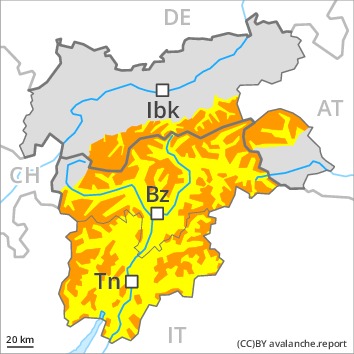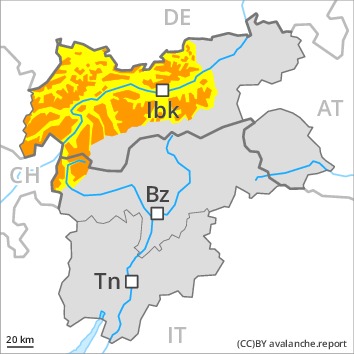
Danger level
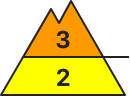 | treeline |
|  |
|  | ||||
| |
|  |
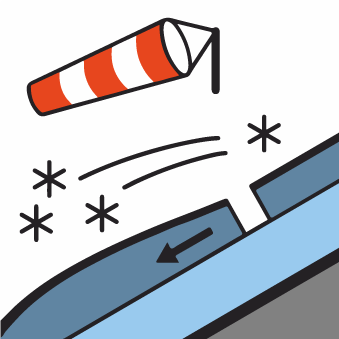
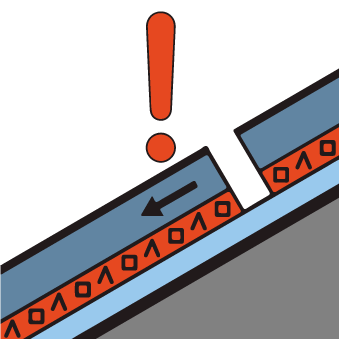

Wind slabs are to be evaluated critically.
Fresh wind slabs represent the main danger. The fresh and somewhat older wind slabs can be released easily, even by a single winter sport participant, in all aspects, caution is to be exercised in particular adjacent to ridgelines and in gullies and bowls. Mostly the avalanches are medium-sized. The number and size of avalanche prone locations will increase with altitude.
Weak layers in the lower part of the snowpack can still be released in isolated cases by individual winter sport participants. Caution is to be exercised in particular on steep shady slopes above approximately 2200 m, especially in areas where the snow cover is rather shallow, as well as at transitions from a shallow to a deep snowpack, when entering gullies and bowls for example.
Snowpack
dp.6: cold, loose snow and wind
dp.1: deep persistent weak layer
The strong wind has transported the fresh and old snow significantly. In many cases wind slabs are lying on soft layers, also below the tree line. The wind slabs will be deposited on surface hoar in some places at intermediate and high altitudes. Snow profiles confirm this situation.
Steep shady slopes: The old snowpack will be prone to triggering in some places. Towards its base, the snowpack is faceted and weak. Whumpfing sounds and the formation of shooting cracks when stepping on the snowpack are a clear indication of a weakly bonded snowpack.
Tendency
Fresh wind slabs are to be evaluated with care and prudence.