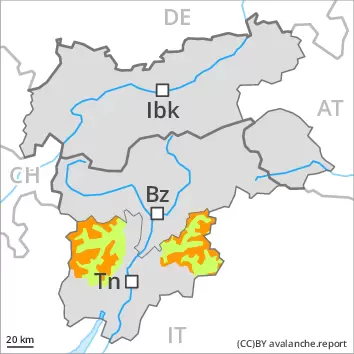
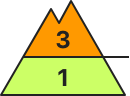
As a consequence of a strong to storm force northerly wind, further wind slabs will form. In particular adjacent to ridgelines in all aspects as well as above the tree line easily released wind slabs will form. Mostly the avalanches are small but in isolated cases easily released. Weak layers exist in the snowpack on shady slopes. Dry avalanches can be released in deep layers, even by small loads in isolated cases.
Snowpack
At high altitudes and in high Alpine regions less snow than usual is lying. The strong wind has transported the loosely bonded old snow. The mostly small wind slabs are poorly bonded with the old snowpack. Weak layers exist in the centre of the snowpack, especially at high altitudes and in high Alpine regions.
Tendency
As a consequence of the strong northerly wind there will be an increase in the avalanche danger within the current danger level.
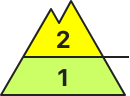
Danger level
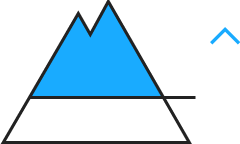
treeline
Avalanche Problem
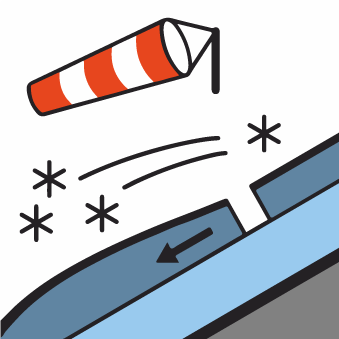
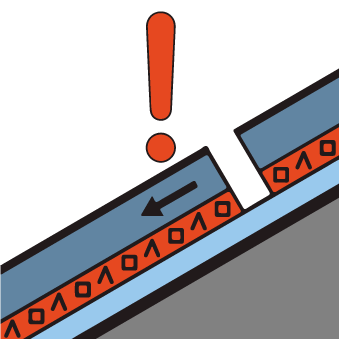
Wind-drifted snow
Treeline
Fresh wind slabs represent the main danger.
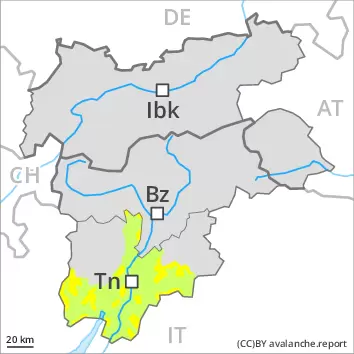
As a consequence of a strong to storm force northerly wind, further wind slabs will form. In particular adjacent to ridgelines in all aspects as well as above the tree line mostly small wind slabs will form. Individual avalanche prone locations are to be found especially on very steep shady slopes above approximately 1900 m. Mostly the avalanches are small but in isolated cases easily released.
Snowpack
At high altitudes and in high Alpine regions less snow than usual is lying. The strong wind has transported the loosely bonded old snow. The mostly small wind slabs are poorly bonded with the old snowpack in particular on steep shady slopes and generally at high altitudes and in high Alpine regions. Below the tree line from a snow sport perspective, insufficient snow is lying.
Tendency
As a consequence of the strong northerly wind there will be an increase in the avalanche danger within the current danger level.