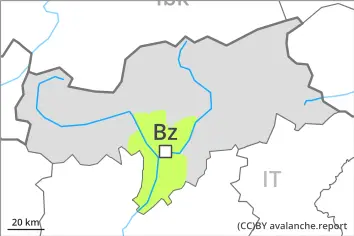
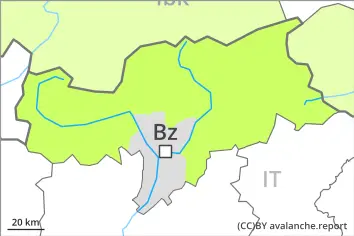
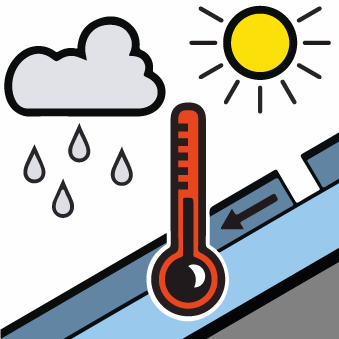
Even single freeriders can release avalanches easily. As a consequence of warming, the natural activity of wet avalanches will appreciably increase.
As a consequence of new snow and warming a dangerous avalanche situation will persist.
As a consequence of new snow and a strong to storm force northwesterly wind, further wind slabs formed in gullies and bowls and behind abrupt changes in the terrain. The new snow and wind slabs of the last few days are lying on top of a weakly bonded old snowpack. This applies on west, north and east facing slopes. The avalanche prone locations are numerous, especially in areas close to the tree line, as well as above the tree line. Winter sport participants can release avalanches easily, including large ones. Remotely triggered avalanches are possible.
As a consequence of warming during the day and solar radiation loose snow avalanches are to be expected as the day progresses. This applies in particular on steep sunny slopes. In particular on steep, rather lightly snow-covered east and west facing slopes the wet avalanches can penetrate even deep layers and reach large size in isolated cases.
In addition gliding avalanches are possible. This applies especially on cut and grassy slopes below approximately 2000 m.
Snowpack
dp.1: deep persistent weak layer dp.10: springtime scenario
15 to 30 cm of snow, and even more in some localities, fell on Tuesday. The wind was strong to storm force in some cases. The wind has transported the new snow significantly. Further wind slabs formed. On Wednesday it will be very mild.
The snowpack will be prone to triggering over a wide area. The new snow and wind slabs are lying on top of a weakly bonded old snowpack. Distinct weak layers exist in the bottom section of the old snowpack. This applies in particular on west, north and east facing slopes in areas close to the tree line, and above the tree line.
The rain gave rise to thorough wetting of the snowpack at low and intermediate altitudes.
Tendency
As a consequence of warming and solar radiation, the activity of wet avalanches will increase.
Danger level
1800m
Avalanche Problem
Persistent weak layer
1800m
Wind slab
2400m
Wet snow
Weakly bonded old snow requires caution. In particular, however, the danger of wet avalanches will increase.
Avalanches can be released in the old snowpack and reach large size in isolated cases on west, north and east facing slopes. This applies in case of a single winter sport participant. The avalanche prone locations are to be found in particular above approximately 1800 m. In their paths avalanches can entrain the wet snow. This extends the avalanche runout distances.
The fresh wind slabs are prone to triggering in particular on steep west, north and east facing slopes at elevated altitudes.
As a consequence of warming during the day and solar radiation small and medium-sized wet avalanches are to be expected. This applies in particular on very steep sunny slopes, and at the base of rock walls. The runout zones are to be treated with caution.
Snowpack
dp.1: deep persistent weak layer dp.10: springtime scenario
Distinct weak layers exist in the old snowpack in particular on west, north and east facing slopes.
Outgoing longwave radiation during the night will be good at times. The weather conditions as the day progresses will give rise to thorough wetting of the snowpack. This applies especially on very steep sunny slopes below approximately 2400 m.
Tendency
As a consequence of warming and solar radiation, the activity of wet avalanches will appreciably increase.
Danger level
treeline
Avalanche Problem
Persistent weak layer
Treeline
Wet snow
Weak layers in the old snowpack can be released in isolated cases.
Avalanches can in isolated cases be released in the old snowpack and reach medium size on west, north and east facing slopes. This applies in case of a single winter sport participant. In their paths avalanches can entrain the wet snow.
As a consequence of warming during the day and solar radiation individual small and medium-sized wet avalanches are to be expected.
Snowpack
dp.1: deep persistent weak layer dp.10: springtime scenario
Distinct weak layers exist in the old snowpack in particular on west, north and east facing slopes.
Outgoing longwave radiation during the night will be quite good over a wide area. The weather conditions as the day progresses will give rise to thorough wetting of the snowpack.