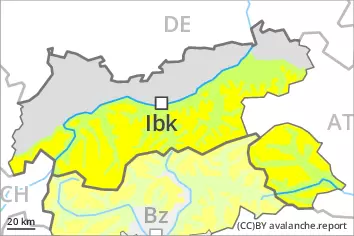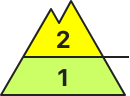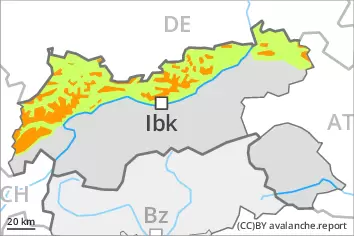
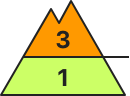
Danger level
 | treeline |
|  |
|  | ||||
|  |
|  |
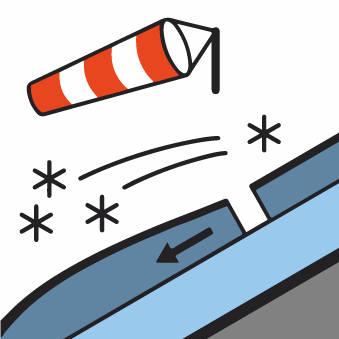

Fresh wind slabs represent the main danger.
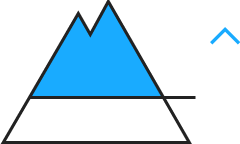
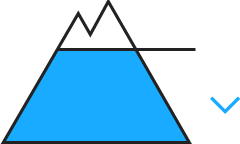
The fresh wind slabs will be deposited on the unfavourable surface of an old snowpack. These can be released by a single winter sport participant above the tree line. This also applies in areas close to the tree line. The wind slabs are clearly recognisable to the trained eye. They are to be avoided as far as possible. The avalanche prone locations are quite prevalent. Such avalanche prone locations are to be found in particular in gullies and bowls in all aspects, but in isolated cases also adjacent to ridgelines. Avalanches are medium-sized. Restraint should be exercised because avalanches can sweep people along and give rise to falls.
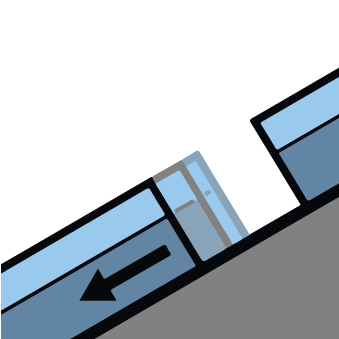
In addition further individual gliding avalanches are possible, in particular on steep east, south and west facing slopes below approximately 2600 m. In isolated cases the gliding avalanches are quite large, in particular in the regions with a lot of snow. Areas with glide cracks are to be avoided.
Snowpack
dp.6: cold, loose snow and wind
5 to 15 cm of snow will fall. As a consequence of new snow and a strong wind from westerly directions, further wind slabs will form in the course of the day in particular in gullies and bowls and behind abrupt changes in the terrain. The fresh wind slabs will be deposited on the unfavourable surface of an old snowpack.
Towards its base, the snowpack is largely stable. Snow depths vary greatly above the tree line, depending on the infuence of the wind. The snowpack will be subject to considerable local variations. The high temperatures will give rise to slight moistening of the snowpack in particular at low and intermediate altitudes.
Tendency
The fresh wind slabs are bonding only slowly with the old snowpack. Slight decrease in danger of dry avalanches.