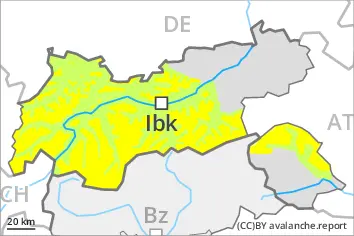
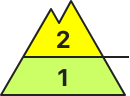
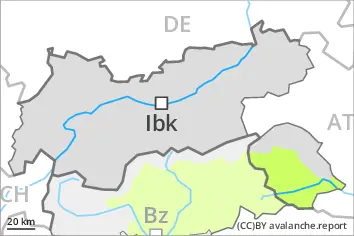
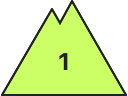
Fresh wind slabs represent the main danger. Avalanches can be released in the weakly bonded old snow in isolated cases. The avalanche danger is within the upper range of danger level 2 (moderate).
As a consequence of new snow and a moderate to strong wind from northwesterly directions, easily released wind slabs formed in gullies and bowls and behind abrupt changes in the terrain. The avalanche prone locations are to be found in particular on northwest to north to southeast facing aspects above the tree line. The number and size of avalanche prone locations will increase with altitude. These places are quite prevalent but are clearly recognisable to the trained eye. Shooting cracks when stepping on the snowpack serve as an alarm indicating the danger. Avalanches can reach medium size.
Additionally in isolated cases avalanches can be triggered in the old snowpack and reach dangerously large size, in particular on very steep northwest, north and east facing slopes above approximately 2400 m. Especially slopes adjacent to ridgelines are unfavourable.
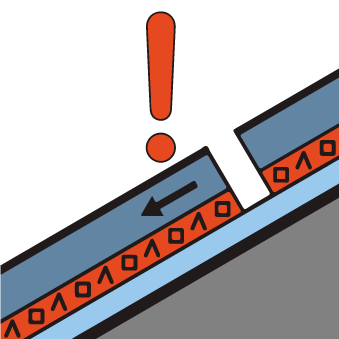
As a consequence of warming small gliding avalanches and snow slides are possible. This applies on very steep sunny slopes.
Snowpack
dp.6: cold, loose snow and wind dp.1: deep persistent weak layer
In some regions up to 15 cm of snow has fallen. This applies in particular in the north and in the west as well as in the High Tauern. The northwesterly wind has transported the fresh and old snow significantly. The fresh wind slabs are lying on unfavourable layers.
Faceted weak layers exist in the centre of the old snowpack, especially on northwest, north and east facing slopes above approximately 2400 m.
In all altitude zones only a little snow is lying.
Tendency
The fresh wind slabs of the last few days remain in some cases prone to triggering. Additionally avalanches can also penetrate near-ground layers of the snowpack and reach quite a large size. Caution is to be exercised in particular adjacent to ridgelines and in gullies and bowls.
Danger level
treeline
Avalanche Problem
Wind slab
Treeline
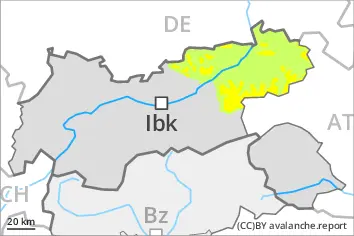
Fresh wind slabs represent the main danger.
As a consequence of new snow and a sometimes strong wind from northwesterly directions, avalanche prone wind slabs formed in gullies and bowls and behind abrupt changes in the terrain. The avalanche prone locations are to be found in particular on northwest to north to southeast facing aspects above the tree line, but in isolated cases also in areas close to the tree line. Avalanches can reach medium size in isolated cases. The avalanche prone locations are clearly recognisable to the trained eye.
In addition individual small gliding avalanches are possible. This applies on very steep grassy slopes.
Snowpack
dp.6: cold, loose snow and wind dp.2: gliding snow
5 to 10 cm of snow has fallen since Sunday. The wind was strong in some cases. Up to intermediate altitudes rain will fall in the late morning in particular along the border with Salzburg. The wind has transported the fresh and old snow. The fresh wind slabs are lying on unfavourable layers. In all altitude zones only a little snow is lying.
Tendency
As a consequence of mild temperatures the snow drift accumulations will stabilise. Fresh wind slabs are to be evaluated with care and prudence especially on very steep shady slopes at high altitude.
Danger level
treeline
Avalanche Problem
Wind slab
Treeline
Fresh wind slabs require caution.
As a consequence of a sometimes strong northerly wind, clearly visible wind slabs formed. These are mostly only small but prone to triggering. Individual avalanche prone locations are to be found in particular in gullies and bowls, and behind abrupt changes in the terrain above the tree line.
Snowpack
dp.6: cold, loose snow and wind
As a consequence of a strong northerly foehn wind, mostly small wind slabs formed. These are lying on unfavourable layers.
In all altitude zones only a little snow is lying. Snow depths vary greatly, depending on the infuence of the wind. Faceted weak layers exist in the bottom section of the snowpack in particular on shady slopes.
Tendency
The mostly shallow wind slabs of the weekend remain prone to triggering in particular on very steep shady slopes.