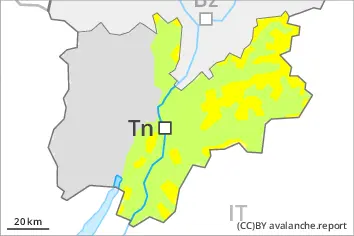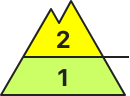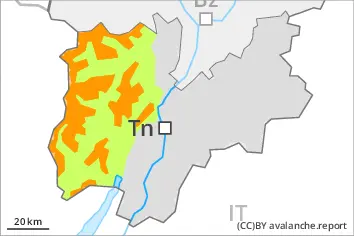
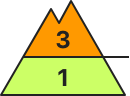
Danger level
 | treeline |
|  |
|  | ||||
| |
|  |
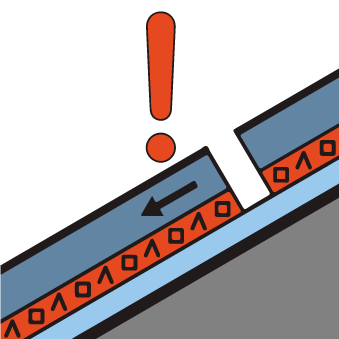


Weakly bonded old snow represents the main danger. Fresh wind slabs require caution.
Avalanches can be released in the weakly bonded old snow. These avalanche prone locations are to be found especially on steep west, north and east facing slopes above the tree line, caution is to be exercised in particular in areas where the snow cover is rather shallow, as well as at transitions from a shallow to a deep snowpack. In particular in regions exposed to heavier precipitation the avalanche prone locations are more widespread and the danger is greater. Whumpfing sounds and the formation of shooting cracks when stepping on the snowpack can indicate the danger. Avalanches can reach medium size.
The older wind slabs can be released by a single winter sport participant in particular on west to north to east facing aspects. Avalanches can reach medium size in particular on shady slopes. The fresh wind slabs can be released by a single winter sport participant in isolated cases also on steep sunny slopes. At high altitude and in the regions exposed to heavier precipitation the avalanche prone locations are more prevalent.
Snowpack
dp.7: snow-poor zones in snow-rich surrounding
dp.6: cold, loose snow and wind
As a consequence of a strong wind from northerly directions, sometimes avalanche prone wind slabs will form in particular in gullies and bowls and behind abrupt changes in the terrain. The older wind slabs are lying on soft layers in particular on steep northwest, north and east facing slopes.
Precarious weak layers exist deep in the old snowpack especially on shady slopes.
Tendency
Wind slabs and weakly bonded old snow are to be critically assessed. Until Monday the weather will be cold. These weather conditions will prevent a rapid stabilisation of the snow drift accumulations.