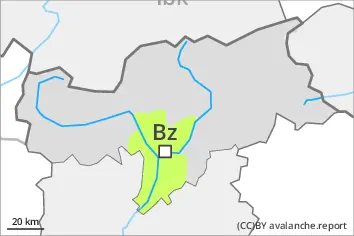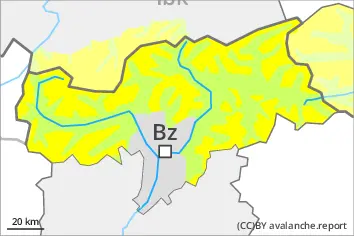
Danger level
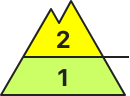 | treeline |
|  |
|  | ||||
| |
|  |
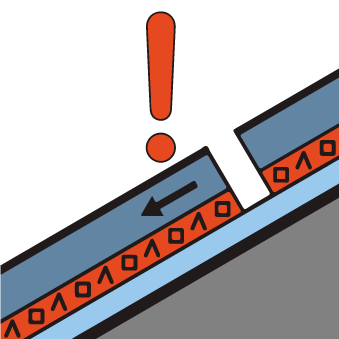


Weakly bonded old snow represents the main danger. Fresh wind slabs require caution.
Weak layers in the old snowpack can still be released in very isolated cases by winter sport participants in particular in little used terrain. Avalanches can in isolated cases penetrate deep layers and reach large size. The avalanche prone locations are barely recognisable, even to the trained eye. Such avalanche prone locations are to be found in particular on very steep west, north and east facing slopes above the tree line.
As a consequence of a moderate to strong wind from northerly directions, sometimes avalanche prone wind slabs formed, especially on near-ridge shady slopes.
Snowpack
dp.1: deep persistent weak layer
dp.6: cold, loose snow and wind
Above the tree line snow depths vary greatly, depending on the infuence of the wind.
Faceted weak layers exist in the bottom section of the snowpack especially on west, north and east facing slopes. These are in some cases prone to triggering.
As a consequence of wind from northerly directions, mostly small wind slabs formed in the last few days especially adjacent to ridgelines and in gullies and bowls.
As a consequence of mild temperatures and solar radiation a crust formed on the surface during the last few days, especially on steep sunny slopes below approximately 2800 m.
The snowpack will be soft on wind-protected shady slopes.
Tendency
Wind slabs and weakly bonded old snow require caution.