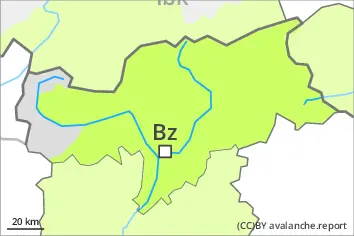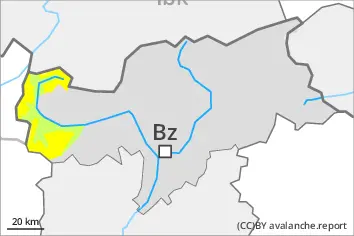
Danger level
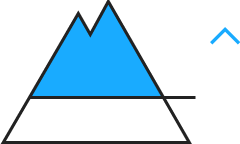
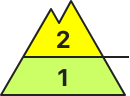 | 2400m |
|  |
|  |
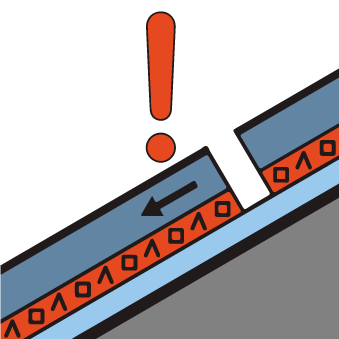

Avalanches can in very isolated cases be released in the old snowpack.
Weak layers in the old snowpack can be released in very isolated cases in little used terrain. The avalanche prone locations are to be found on extremely steep west, north and east facing slopes above approximately 2400 m. These avalanche prone locations are barely recognisable, even to the trained eye. Caution is to be exercised in particular at transitions from a shallow to a deep snowpack, when entering gullies and bowls for example. Avalanches can reach medium size in isolated cases.
The hard wind slabs are in individual cases still prone to triggering on steep shady slopes at elevated altitudes. Such avalanche prone locations are to be found in particular in gullies and bowls, and behind abrupt changes in the terrain. They are clearly recognisable to the trained eye. Restraint should be exercised because avalanches can sweep people along and give rise to falls.
As the moisture increases wet loose snow avalanches are possible, but they will be mostly small. On steep grassy slopes mostly small gliding avalanches are possible.
Snowpack
dp.1: deep persistent weak layer
dp.10: springtime scenario
Faceted weak layers exist in the bottom section of the snowpack on west, north and east facing slopes. These can be released in isolated cases.
The hard wind slabs are lying on soft layers in particular on steep shady slopes. They are mostly rather small.
Steep sunny slopes: The snowpack is well consolidated and its surface has a crust that is barely capable of bearing a load. The solar radiation will give rise as the day progresses to gradual softening of the snowpack on steep sunny slopes.
In some regions an overcast night. This situation will give rise to increasing softening of the snowpack.
The snowpack will be moist at low and intermediate altitudes. Only a small amount of snow is lying for the time of year.
Tendency
Currently there are quite favourable conditions generally.