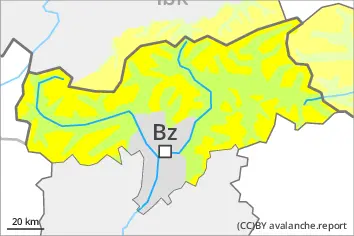
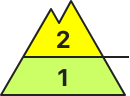
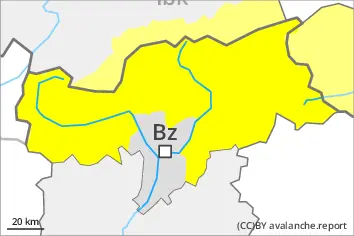
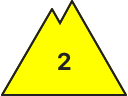
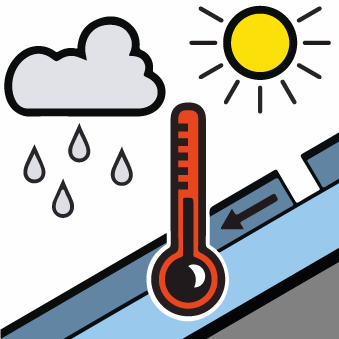
Increase in danger of wet avalanches as a consequence of warming during the day and solar radiation. Weakly bonded old snow requires caution.
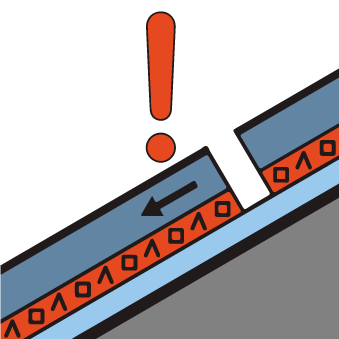
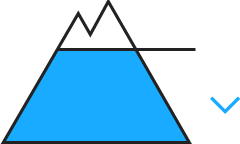
An increasing number of small and medium-sized wet and gliding avalanches are possible as a consequence of warming during the day and solar radiation. This applies in particular on steep north and east facing slopes below approximately 2200 m, and elsewhere below approximately 2600 m.
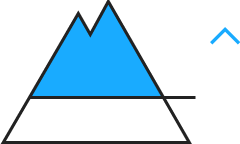
Weak layers in the old snowpack can still be released in isolated cases by individual winter sport participants. The avalanche prone locations are to be found in particular on steep, little used west, north and east facing slopes above approximately 2200 m. Mostly avalanches are medium-sized. In isolated cases avalanches can also release deeper layers of the snowpack and reach large size.
In addition the mostly small wind slabs should be taken into account, in particular on very steep shady slopes adjacent to ridgelines in high Alpine regions. Restraint should be exercised because avalanches can sweep people along and give rise to falls.
Snowpack
dp.10: springtime scenario dp.5: snowfall after a long period of cold
The surface of the snowpack will freeze to form a strong crust. Sunshine and high temperatures will give rise as the day progresses to increasing softening of the snowpack.
Avalanche prone weak layers exist in the old snowpack especially on little used west, north and east facing slopes. The mostly small wind slabs are lying on soft layers in particular on very steep shady slopes in high Alpine regions.
The snowpack will be generally subject to considerable local variations. Below the tree line only a little snow is now lying.
Tendency
The surface of the snowpack will cool hardly at all during the overcast night. Some snow will fall in some regions, in particular on the Main Alpine Ridge and in the High Tauern.
Danger level
Avalanche Problem
Wet snow
Low avalanche danger will prevail.
On very steep slopes individual mostly small wet loose snow avalanches are possible. Avalanches can in very isolated cases be released by a single winter sport participant. The avalanche prone locations are to be found in particular on very steep shady slopes above approximately 2200 m. Mostly avalanches are small.
Snowpack
The surface of the snowpack will freeze to form a strong crust. Sunshine and high temperatures will give rise as the day progresses to increasing softening of the snowpack. Isolated avalanche prone weak layers exist in the old snowpack especially on steep shady slopes.
The snowpack will be generally subject to considerable local variations. Below the tree line only a little snow is now lying.
Tendency
Low avalanche danger will prevail. The surface of the snowpack will cool hardly at all during the overcast night.