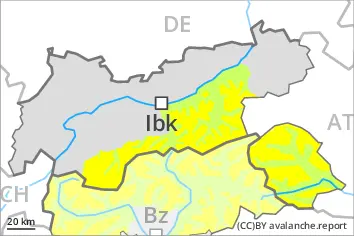
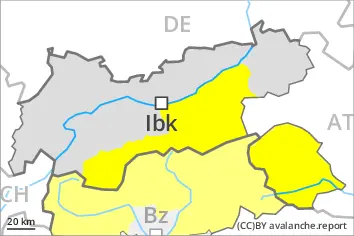
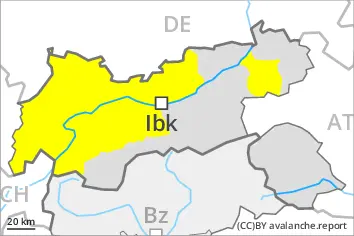
Weakly bonded old snow requires caution. Increase in danger of wet avalanches as a consequence of warming during the day and solar radiation.
Weak layers in the old snowpack can be released in isolated cases by individual winter sport participants. These avalanche prone locations are to be found in particular on steep, little used shady slopes above approximately 2400 m and on steep, little used west and east facing slopes above approximately 2600 m. Avalanches can in very isolated cases release deeper layers of the snowpack and reach large size. This applies in the regions exposed to heavier precipitation. As a consequence of warming during the day and solar radiation more frequent wet avalanches are to be expected, even medium-sized ones. This applies in particular on very steep sunny slopes below approximately 2800 m, as well as on very steep west facing slopes below approximately 2600 m. They can in some cases release the saturated snowpack.
Gliding avalanches can also occur. This applies on grassy slopes below approximately 2400 m.
Snowpack
dp.10: springtime scenario dp.2: gliding snow
The fresh and older wind slabs are lying on soft layers on shady slopes above approximately 2400 m.
Avalanche prone weak layers exist in the old snowpack especially on little used west, north and east facing slopes. This applies on shady slopes above approximately 2200 m, as well as on west and east facing slopes above approximately 2600 m. Sunshine and high temperatures will give rise to increasing and thorough wetting of the snowpack over a wide area in particular on sunny slopes below approximately 2800 m. The surface of the snowpack will freeze to form a strong crust and will soften during the day.
Tendency
Sunshine and high temperatures will give rise as the day progresses to increasing and thorough wetting of the snowpack.
EARLIER Danger level
2400m
Avalanche Problem
Wind slab
2400m
LATER Danger level
2800m
Avalanche Problem
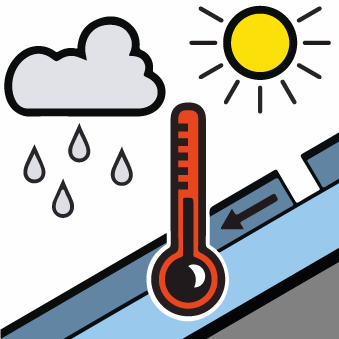
Wet snow
2800m
Wind slab
2400m
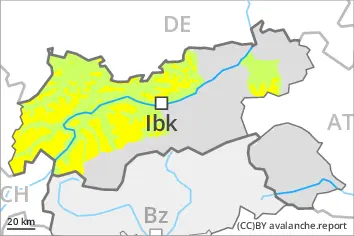
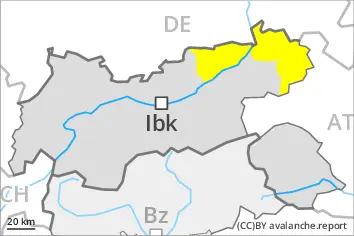
Wind slabs require caution. Increase in danger of wet avalanches as a consequence of warming during the day and solar radiation.
Wind slabs can in isolated cases be released by a single winter sport participant. Caution is to be exercised in particular on very steep shady slopes, as well as in gullies and bowls, and behind abrupt changes in the terrain above approximately 2400 m. Avalanches are medium-sized.
As a consequence of warming during the day and the solar radiation, the likelihood of wet avalanches being released will increase appreciably. Caution is to be exercised in particular on very steep sunny slopes below approximately 2800 m, as well as on very steep west facing slopes below approximately 2600 m. Avalanches can in some cases release the saturated snowpack.
Gliding avalanches can also occur. This applies on grassy slopes below approximately 2400 m.
Snowpack
dp.10: springtime scenario dp.2: gliding snow
The fresh and older wind slabs of the last few days are lying on soft layers in particular on very steep shady slopes above approximately 2400 m.
Sunshine and high temperatures will give rise to increasing and thorough wetting of the snowpack over a wide area in particular on sunny slopes below approximately 2800 m. The surface of the snowpack will freeze to form a strong crust and will soften during the day.
Tendency
Sunshine and high temperatures will give rise as the day progresses to increasing and thorough wetting of the snowpack.
EARLIER Danger level
LATER Danger level
Avalanche Problem
Wet snow
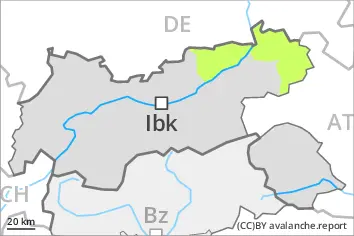
Increase in danger of wet avalanches as a consequence of warming during the day and solar radiation.
As a consequence of warming during the day and the solar radiation, the likelihood of wet avalanches being released will increase appreciably. Caution is to be exercised in particular on very steep sunny slopes. Avalanches can in some cases release the saturated snowpack.
Gliding avalanches can also occur. This applies on grassy slopes below approximately 2400 m.
Snowpack
dp.10: springtime scenario dp.2: gliding snow
Sunshine and high temperatures will give rise to increasing and thorough wetting of the snowpack in particular on sunny slopes. The surface of the snowpack will freeze to form a strong crust and will soften during the day.
Tendency
Sunshine and high temperatures will give rise as the day progresses to increasing and thorough wetting of the snowpack.