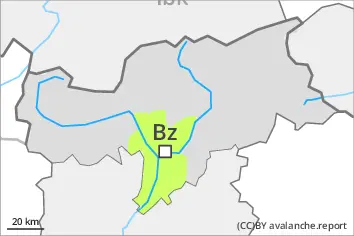
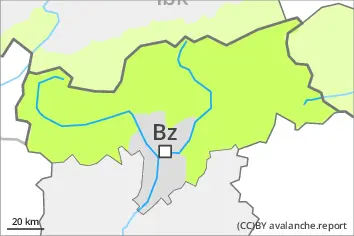
Avalanches can in very isolated cases be released by a single winter sport participant. The avalanche prone locations are to be found in particular on very steep shady slopes at elevated altitudes. Mostly avalanches are small.
Snowpack
Isolated avalanche prone weak layers exist in the old snowpack especially on steep shady slopes.
The snowpack will be generally subject to considerable local variations. Only a little snow is now lying.
Tendency
Low avalanche danger will prevail.
Danger level
A favourable avalanche situation will be encountered over a wide area.
Weak layers in the old snowpack can still be released in very isolated cases by winter sport participants. These avalanche prone locations are to be found in particular on extremely steep shady slopes above approximately 2400 m and on very steep west and east facing slopes above approximately 2800 m. Avalanches can in some cases reach medium size.
As a consequence of warming during the day and the solar radiation, the likelihood of moist avalanches being released will increase a little.
The mostly small wind slabs of the last few days are in some cases prone to triggering especially on very steep shady slopes in high Alpine regions. Restraint should be exercised because avalanches can sweep people along and give rise to falls.
Individual gliding avalanches can also occur. This applies on steep grassy slopes below approximately 2600 m.
Snowpack
dp.1: deep persistent weak layer dp.6: cold, loose snow and wind
Outgoing longwave radiation during the night will be good. The surface of the snowpack has frozen to form a strong crust and will soften during the day. This applies in particular on sunny slopes. Towards its base, the snowpack is moist, especially on shady slopes below approximately 2200 m, as well as on sunny slopes.
Isolated avalanche prone weak layers exist in the old snowpack especially on little used west, north and east facing slopes. This applies on shady slopes above approximately 2400 m, as well as on west and east facing slopes above approximately 2800 m.
The fresh wind slabs are lying on soft layers on shady slopes in high Alpine regions.
Tendency
Slight increase in avalanche danger as a consequence of warming during the day and solar radiation. Individual avalanche prone locations for dry avalanches are to be found in particular on extremely steep slopes above approximately 2400 m.