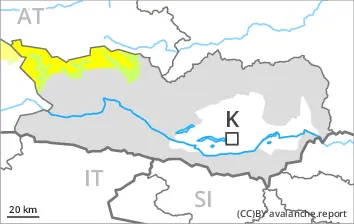
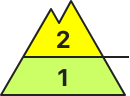
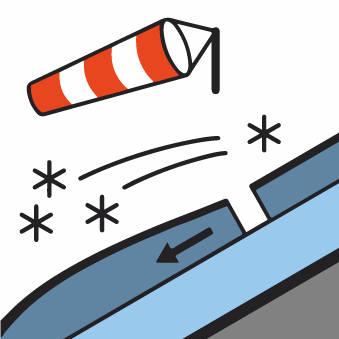
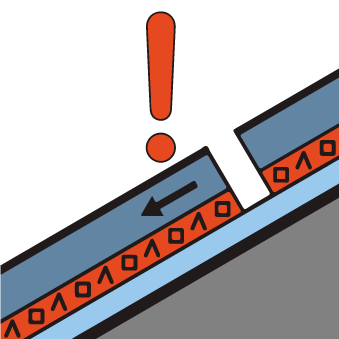
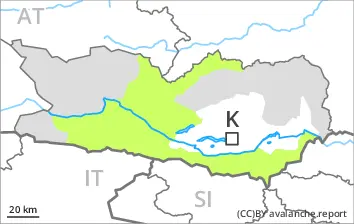
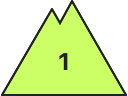
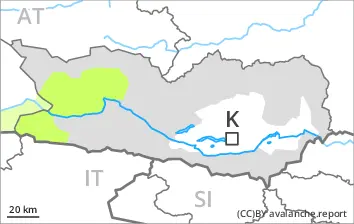
Wind slabs require caution. Weakly bonded old snow at elevated altitudes.
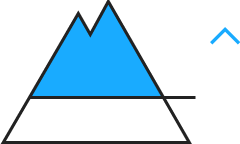
The fresh and older wind slabs can be released by a single winter sport participant in isolated cases especially on very steep west, north and east facing slopes. The avalanche prone locations are to be found in particular in gullies and bowls, and behind abrupt changes in the terrain above approximately 2400 m. Avalanches can reach medium size in isolated cases. Apart from the danger of being buried, restraint should be exercised as well in view of the danger of avalanches sweeping people along and giving rise to falls.
In isolated cases avalanches can also be released in near-ground layers, in particular on very steep shady slopes at elevated altitudes. Steep, glaciated terrain must also be critically assessed.
The Avalanche Warning Service currently has only a small amount of information that has been collected in the field, so that the avalanche danger should be investigated especially thoroughly in the relevant locality.
Snowpack
dp.6: cold, loose snow and wind dp.1: deep persistent weak layer
A little snow is lying. The snowpack will be subject to considerable local variations. The fresh and somewhat older wind slabs are lying on top of a weakly bonded old snowpack on west, north and east facing slopes at elevated altitudes. Faceted weak layers exist in the bottom section of the old snowpack in shady places that are protected from the wind. The high temperatures gave rise to moistening of the snowpack at intermediate altitudes.
Tendency
Wind slabs and weakly bonded old snow require caution.
Danger level
The avalanche prone locations are rare.
The fresh and older wind slabs can be released in isolated cases, but mostly only by large additional loads, on extremely steep shady slopes, in particular in gullies and bowls at high altitude. Avalanches are small.
Karawanks West, Karwanks Central, Karawanks East: Weak layers near the ground can be released by large additional loads on northwest, north and northeast facing slopes. This applies in gullies and bowls above approximately 1800 m. In very isolated cases avalanches are medium-sized.
Restraint should be exercised because avalanches can sweep people along and give rise to falls. The Avalanche Warning Service currently has only a small amount of information that has been collected in the field, so that the avalanche danger should be investigated especially thoroughly in the relevant locality.
Snowpack
From a snow sport perspective, in most cases insufficient snow is lying. The snowpack will be subject to considerable local variations.
The fresh and older wind slabs are lying on top of a weakly bonded old snowpack especially on steep shady slopes at high altitude.
Karawanks West, Karwanks Central, Karawanks East: Faceted weak layers exist in the bottom section of the old snowpack in places that are protected from the wind. This applies in particular on northwest, north and northeast facing slopes above approximately 1800 m.
The high temperatures gave rise to moistening of the snowpack at intermediate altitudes.
Tendency
Danger level
Wind slabs require caution. The avalanche prone locations are rare.
The older wind slabs can be released in isolated cases, but mostly only by large additional loads, on very steep west, north and east facing slopes. The avalanche prone locations are to be found in particular in gullies and bowls above approximately 2400 m. The mostly small wind slabs are clearly recognisable to the trained eye. Restraint should be exercised because avalanches can sweep people along and give rise to falls.
The Avalanche Warning Service currently has only a small amount of information that has been collected in the field, so that the avalanche danger should be investigated especially thoroughly in the relevant locality.
Snowpack
From a snow sport perspective, in most cases insufficient snow is lying. The snowpack will be subject to considerable local variations.
The older wind slabs are lying on top of a weakly bonded old snowpack especially on steep shady slopes. The high temperatures gave rise to moistening of the snowpack at intermediate altitudes.