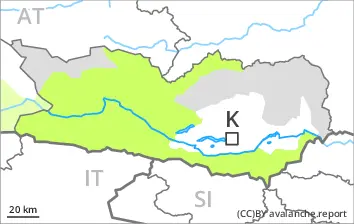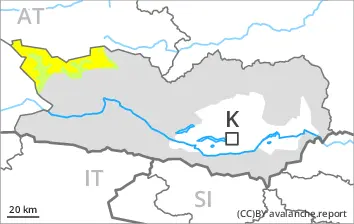
Danger level
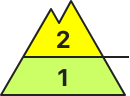 | 2600m |
|  |
|  | ||||
| |
| |

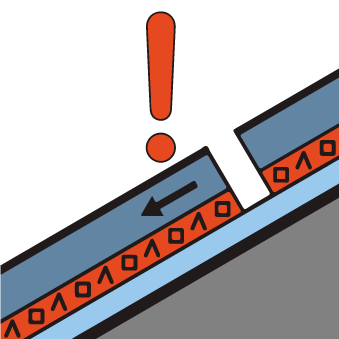

Fresh wind slabs are to be avoided. Weakly bonded old snow requires caution.
The fresh wind slabs can be released by a single winter sport participant in particular on steep west, north and east facing slopes. Such avalanche prone locations are to be found in gullies and bowls, and behind abrupt changes in the terrain at high altitudes and in high Alpine regions. Avalanches are rather small.
In very isolated cases avalanches can be triggered in the weakly bonded old snow and reach medium size in isolated cases.
Apart from the danger of being buried, restraint should be exercised in particular in view of the danger of avalanches sweeping people along and giving rise to falls.
Snowpack
dp.6: cold, loose snow and wind
dp.1: deep persistent weak layer
In particular in the Glockner Range Pasterze and along the border with Salzburg 15 cm of snow, and even more in some localities, will fall until the early morning above approximately 2500 m.
As a consequence of a moderate wind from northwesterly directions, sometimes avalanche prone wind slabs will form at high altitudes and in high Alpine regions. The wind slabs will be deposited on the unfavourable surface of an old snowpack on shady slopes. They are lying on surface hoar in some places. Faceted weak layers exist in the old snowpack.
Steep sunny slopes: The high temperatures will give rise to rapid moistening of the snowpack.
The snowpack will be subject to considerable local variations. From a snow sport perspective, in most cases insufficient snow is lying.
Tendency
The weather will be mild. Gradual decrease in avalanche danger.