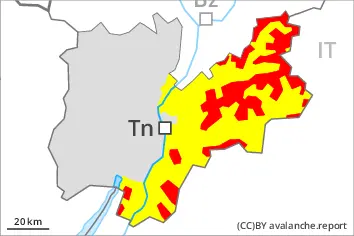
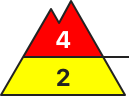
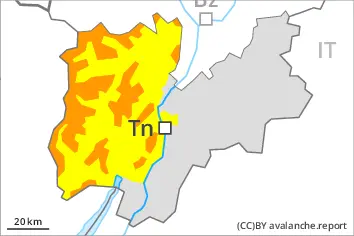
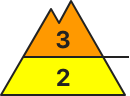
The conditions are very precarious for backcountry touring and other off-piste activities.
Wind slabs and weakly bonded old snow require caution. Natural avalanches and loose snow slides are likely to occur.
The fresh snow of the last few days as well as the deep wind slabs are lying on the unfavourable surface of an old snowpack. In particular on wind-loaded slopes avalanches can be released easily and reach large size in isolated cases. Whumpfing sounds and the formation of shooting cracks when stepping on the snowpack and natural avalanches serve as an alarm indicating the danger. Remotely triggered avalanches are possible. Distinct weak layers in the lower part of the snowpack can be released even now easily by individual winter sport participants in particular on west, north and east facing slopes. This applies in particular above the tree line on steep west, north and east facing slopes. The avalanche prone locations are covered with new snow. Such avalanche prone locations are numerous and are barely recognisable, even to the trained eye. The number and size of avalanche prone locations will increase with altitude.
Snowpack
dp.6: cold, loose snow and wind dp.1: deep persistent weak layer
The new snow and wind slabs of the last few days are poorly bonded with the old snowpack above the tree line. Distinct weak layers exist in the old snowpack. This applies especially on west, north and east facing slopes. Night: Over a wide area 5 to 15 cm of snow, and even more in some localities, has fallen above approximately 1200 m.
Tendency
Friday: Over a wide area 5 cm of snow, and even more in some localities, will fall above approximately 1300 m. The avalanche danger will not decrease for the time being.
Danger level
treeline
Avalanche Problem
Wind slab
Treeline
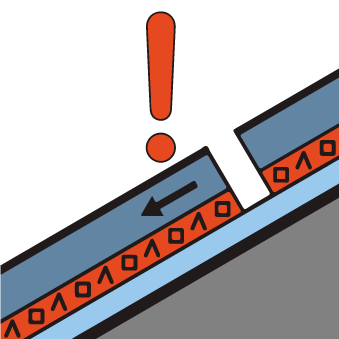
Persistent weak layer
Treeline
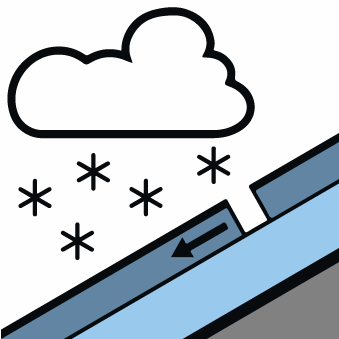
New snow
1000m
The conditions are precarious for backcountry touring and other off-piste activities.
Wind slabs and weakly bonded old snow require caution. Natural avalanches and loose snow slides are likely to occur.
The fresh snow of the last few days as well as the deep wind slabs are lying on the unfavourable surface of an old snowpack. In particular on wind-loaded slopes avalanches can be released easily and reach large size in isolated cases. Whumpfing sounds and the formation of shooting cracks when stepping on the snowpack and natural avalanches serve as an alarm indicating the danger. Remotely triggered avalanches are possible. Distinct weak layers in the lower part of the snowpack can be released even now easily by individual winter sport participants in particular on west, north and east facing slopes. This applies in particular above the tree line on steep west, north and east facing slopes. The avalanche prone locations are covered with new snow. Such avalanche prone locations are numerous and are barely recognisable, even to the trained eye. The number and size of avalanche prone locations will increase with altitude.
Snowpack
dp.6: cold, loose snow and wind dp.1: deep persistent weak layer
The new snow and wind slabs of the last few days are poorly bonded with the old snowpack above the tree line. Distinct weak layers exist in the old snowpack. This applies especially on west, north and east facing slopes. Night: Over a wide area 2 to 5 cm of snow, and even more in some localities, has fallen above approximately 1200 m.
Tendency
Friday: Over a wide area 5 cm of snow, and even more in some localities, will fall above approximately 1300 m. The avalanche danger will persist.