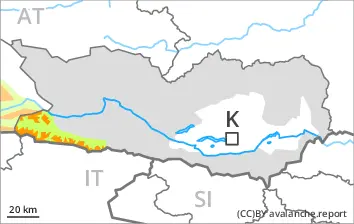
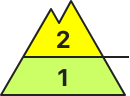
Weak layers in the old snowpack necessitate caution.
Avalanches can as before be released by a single winter sport participant. They can penetrate down to the ground and reach medium size. This applies especially on west, north and east facing slopes above approximately 1800 m. The avalanche prone locations are barely recognisable, even to the trained eye.
Whumpfing sounds and the formation of shooting cracks when stepping on the snowpack can indicate the danger. Remotely triggered avalanches are possible in isolated cases.
Snowpack
dp.1: deep persistent weak layer dp.8: surface hoar blanketed with snow
The snowpack will be prone to triggering above approximately 1800 m. Distinct weak layers exist in the old snowpack. This applies in particular on west, north and east facing slopes above approximately 1800 m,, in isolated cases also in areas close to the tree line.
Steep sunny slopes as well as below approximately 1800 m: The snowpack will be moist. Outgoing longwave radiation during the night will be reduced at times.
Tendency
Avalanches can as before be released by a single winter sport participant.
Danger level
1800m
Avalanche Problem
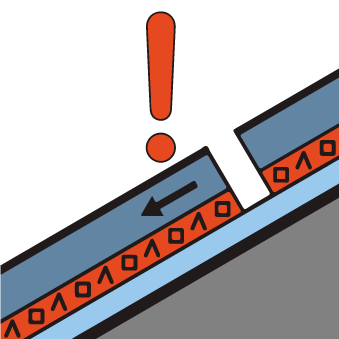
Persistent weak layer
1800m
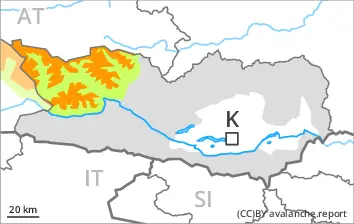
Avalanches can as before be released, even by a single winter sport participant. The snowpack remains prone to triggering.
Avalanches can as before be released easily. They can penetrate down to the ground and reach large size in isolated cases. Caution is to be exercised in particular on steep west, north and east facing slopes above approximately 1800 m as well as in areas close to the tree line. The avalanche prone locations are barely recognisable, even to the trained eye.
Whumpfing sounds and the formation of shooting cracks when stepping on the snowpack serve as an alarm indicating the danger. Remotely triggered avalanches are possible.
Snowpack
dp.1: deep persistent weak layer dp.8: surface hoar blanketed with snow
The snowpack will be prone to triggering above approximately 1800 m. Distinct weak layers exist in the old snowpack. This applies in particular on west, north and east facing slopes above approximately 1800 m as well as in areas close to the tree line.
Steep sunny slopes as well as below approximately 1800 m: The snowpack will be moist. Outgoing longwave radiation during the night will be reduced at times.
Tendency
A treacherous avalanche situation will persist.
Danger level
2000m
Avalanche Problem
Persistent weak layer
2000m
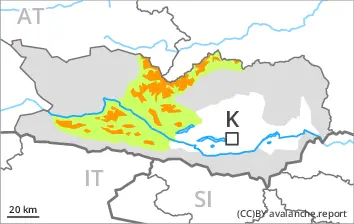
Avalanches can as before be released, even by a single winter sport participant. The snowpack remains prone to triggering.
Avalanches can as before be released easily. Mostly they are medium-sized. Caution is to be exercised in particular on steep west, north and east facing slopes above approximately 2000 m,, in isolated cases also in areas close to the tree line. The avalanche prone locations are barely recognisable, even to the trained eye.
Whumpfing sounds and the formation of shooting cracks when stepping on the snowpack can indicate the danger. Remotely triggered avalanches are possible in isolated cases.
Snowpack
dp.1: deep persistent weak layer dp.8: surface hoar blanketed with snow
The snowpack will be prone to triggering above approximately 2000 m. Distinct weak layers exist in the old snowpack. This applies in particular on west, north and east facing slopes above approximately 2000 m,, in isolated cases also in areas close to the tree line.
Steep sunny slopes as well as below approximately 1800 m: The snowpack will be moist. Outgoing longwave radiation during the night will be reduced at times.
Tendency
Weak layers in the old snowpack necessitate caution. A sometimes treacherous avalanche situation will persist.
Danger level
1800m
Avalanche Problem
Persistent weak layer
1800m
Weak layers in the old snowpack necessitate caution. This applies in particular at elevated altitudes.
Avalanches can be released in the weakly bonded old snow by a single winter sport participant. This applies on west, north and east facing slopes in particular above approximately 1800 m. In many cases avalanches are medium-sized. Remotely triggered avalanches are possible in isolated cases.
The number and size of avalanche prone locations will increase with altitude. Whumpfing sounds and the formation of shooting cracks when stepping on the snowpack can indicate the danger.
Snowpack
dp.1: deep persistent weak layer dp.8: surface hoar blanketed with snow
The snowpack will be prone to triggering above approximately 1800 m. Distinct weak layers exist in the old snowpack. This applies in particular on west, north and east facing slopes above approximately 1800 m.
Steep sunny slopes as well as below approximately 1800 m: The snowpack will be moist. Outgoing longwave radiation during the night will be reduced at times.
Tendency
The avalanche conditions remain unfavourable.
Danger level
1900m
Avalanche Problem
Persistent weak layer
1900m
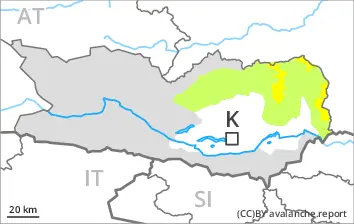
Individual avalanche prone locations are to be found on steep shady slopes at elevated altitudes.
Avalanches can be released in the weakly bonded old snow, even by small loads in isolated cases. This applies in particular on west, north and east facing slopes at elevated altitudes. In isolated cases avalanches are medium-sized.
Whumpfing sounds and the formation of shooting cracks when stepping on the snowpack can indicate the danger.
Snowpack
dp.1: deep persistent weak layer
A little snow is lying.
The snowpack will be unfavourable at elevated altitudes. Distinct weak layers exist in the old snowpack. This applies in particular on west, north and east facing slopes at elevated altitudes.
Steep sunny slopes as well as below approximately 1800 m: The snowpack will be moist. Outgoing longwave radiation during the night will be reduced at times.