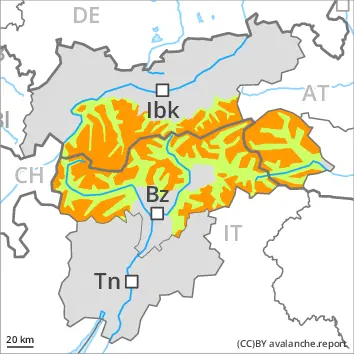
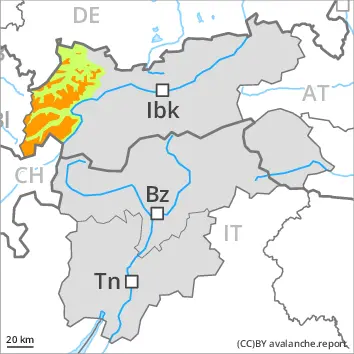
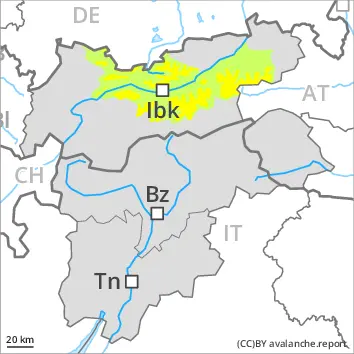
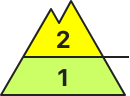
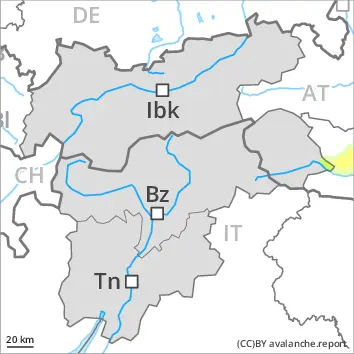
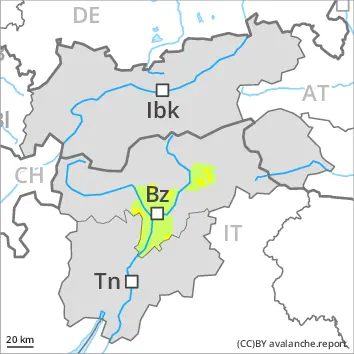
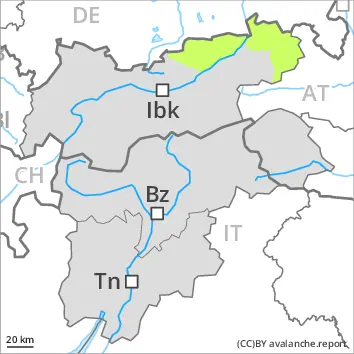
In little used terrain a sometimes treacherous avalanche situation will prevail. Wind slabs and weakly bonded old snow require caution.
Distinct weak layers in the old snowpack can be released easily by individual winter sport participants especially in little used terrain. Mostly they are medium-sized. Caution is to be exercised in particular on steep west, north and east facing slopes above the tree line. The avalanche prone locations are difficult to recognise. Whumpfing sounds and the formation of shooting cracks when stepping on the snowpack serve as an alarm indicating the danger. Remotely triggered avalanches are possible in isolated cases.
As a consequence of the strong wind, fresh snow drift accumulations formed during the last few days, in particular in gullies and bowls, and behind abrupt changes in the terrain above approximately 2200 m. The soft wind slabs are only small but in some cases prone to triggering. They are clearly recognisable to the trained eye.
Snowpack
dp.1: deep persistent weak layer dp.8: surface hoar blanketed with snow
As a consequence of a strong wind from westerly directions, mostly small wind slabs formed in the last few days especially in gullies and bowls. The wind slabs are lying on surface hoar in some places.
Above the tree line: The snowpack will be prone to triggering. Distinct weak layers exist in the old snowpack. This applies in particular on west, north and east facing slopes.
Below the tree line as well as steep sunny slopes: The snowpack is moist and its surface has a crust that is barely capable of bearing a load.
Tendency
Weak layers in the old snowpack represent the main danger.
Some snow will fall until Sunday in particular in the north. The mostly small wind slabs of the last few days will be covered with new snow in some cases and therefore difficult to recognise. As a consequence of a strong northerly foehn wind, further wind slabs will form in the south.
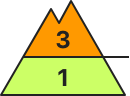
Danger level
treeline
Avalanche Problem
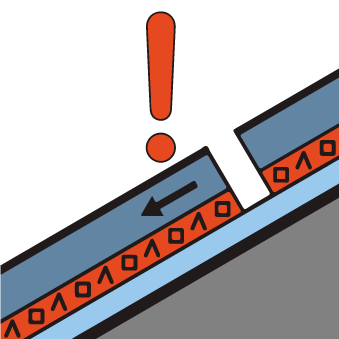
Persistent weak layer
Treeline
Wind slab
Treeline
Distinct weak layers in the old snowpack represent the main danger. In addition the wind slabs should be taken into account.
Weak layers in the old snowpack can be released even easily by individual winter sport participants. Caution is to be exercised in particular on steep west, north and east facing slopes above the tree line. Avalanches can penetrate down to the ground and reach large size in isolated cases. The fresh and somewhat older wind slabs can be released easily or naturally. The avalanche prone locations are sometimes covered with new snow and are barely recognisable because of the poor visibility.
Snowpack
dp.6: cold, loose snow and wind dp.1: deep persistent weak layer
Some snow will fall on Saturday over a wide area. Distinct weak layers exist in the old snowpack. This applies especially on west, north and east facing slopes. The snowpack remains generally prone to triggering. At high altitude the wind slabs have increased in size additionally in the last two days. The snowpack will be moist at low and intermediate altitudes.
Tendency
The avalanche danger will persist. Above the tree line a treacherous avalanche situation will prevail.
Danger level
treeline
Avalanche Problem
Persistent weak layer
Treeline
Wind slab
2200m
A sometimes treacherous avalanche situation will prevail. Wind slabs and weakly bonded old snow require caution.
Distinct weak layers in the old snowpack can be released easily by individual winter sport participants especially in little used terrain. Mostly avalanches are medium-sized. Caution is to be exercised in particular on steep west, north and east facing slopes above the tree line. The avalanche prone locations are difficult to recognise. Whumpfing sounds and the formation of shooting cracks when stepping on the snowpack serve as an alarm indicating the danger. Remotely triggered avalanches are possible in isolated cases.
As a consequence of the strong to storm force westerly wind, fresh snow drift accumulations formed during the last few days. These are in some cases prone to triggering above approximately 2200 m. The fresh wind slabs are clearly recognisable to the trained eye.
The avalanche situation is more favourable in highly frequented off-piste terrain.
Snowpack
dp.1: deep persistent weak layer dp.8: surface hoar blanketed with snow
Over a wide area 15 to 30 cm of snow, and even more in some localities, has fallen since Wednesday. The westerly wind has transported the new snow significantly. The fresh wind slabs are lying on surface hoar in some places, in particular in places that are protected from the wind above approximately 2200 m.
Above the tree line: Distinct weak layers exist in the old snowpack. This applies in particular on west, north and east facing slopes.
Below the tree line: The old snowpack is moist and its surface has a crust that is barely capable of bearing a load.
Tendency
A sometimes treacherous avalanche situation will persist. Weak layers in the old snowpack represent the main danger. 10 to 15 cm of snow will fall until Sunday. The wind will be light to moderate. The wind slabs of the last few days will be covered with new snow and therefore difficult to recognise.
Danger level
treeline
Avalanche Problem
Persistent weak layer
Treeline
Wind slab
2200m
Weakly bonded old snow represents the main danger. Fresh wind slabs require caution.
Avalanches can in some places be released by a single winter sport participant, especially on steep west, north and east facing slopes above the tree line, and in little used backcountry terrain. Mostly avalanches are medium-sized. The avalanche prone locations are difficult to recognise. Isolated whumpfing sounds and shooting cracks when stepping on the snowpack can indicate the danger.
As a consequence of the strong westerly wind, fresh snow drift accumulations formed during the last few days. They are only small but in some cases prone to triggering. This applies in places that are protected from the wind above approximately 2200 m.
Snowpack
dp.1: deep persistent weak layer dp.8: surface hoar blanketed with snow
The fresh wind slabs are lying on surface hoar in some places above approximately 2200 m. This applies in particular in places that are protected from the wind.
The snowpack is unfavourably layered. In its middle, the snowpack is weak in some cases. The old snowpack consists of faceted crystals.
The snowpack will be generally subject to considerable local variations. Only a small amount of snow is lying for the time of year in all altitude zones.
Tendency
Weakly bonded old snow represents the main danger. Over a wide area 5 to 15 cm of snow will fall until Sunday. The mostly small wind slabs of the last few days will be covered with new snow in some cases and therefore difficult to recognise.
Danger level
2000m
Avalanche Problem
Persistent weak layer
2000m
Weak layers in the old snowpack can be released by individual winter sport participants in particular on steep shady slopes.
Avalanches can be released by a single winter sport participant. They can reach medium size. Caution is to be exercised in particular on steep west, north and east facing slopes above approximately 2000 m.
In addition the fresh wind slabs adjacent to ridgelines and in gullies and bowls are prone to triggering in some cases.
The number and size of avalanche prone locations will increase with altitude. Isolated whumpfing sounds can indicate the danger.
Snowpack
dp.1: deep persistent weak layer dp.6: cold, loose snow and wind
Some snow will fall in some regions. The sometimes moderate wind will transport the snow. The fresh wind slabs are lying on the unfavourable surface of an old snowpack at elevated altitudes.
Above approximately 2000 m: The snowpack will be prone to triggering. Distinct weak layers exist in the old snowpack. This applies in particular on west, north and east facing slopes.
Below approximately 2000 m as well as steep sunny slopes: The snowpack is fairly homogeneous and its surface has a crust that is barely capable of bearing a load.
Tendency
Avalanches can as before be released by a single winter sport participant.
Danger level
treeline
Avalanche Problem
Persistent weak layer
Treeline
Wind slabs and weakly bonded old snow require caution.
Avalanches can be released by a single winter sport participant. This applies especially on steep shady slopes adjacent to ridgelines and in gullies and bowls above the tree line. As a consequence of the occasionally strong wind, fresh snow drift accumulations will form. These are in some cases prone to triggering. In some cases avalanches are medium-sized.
Apart from the danger of being buried, restraint should be exercised in particular in view of the danger of avalanches sweeping people along and giving rise to falls. Only a small amount of snow is lying for the time of year.
Snowpack
dp.6: cold, loose snow and wind
The fresh and older wind slabs are lying on the unfavourable surface of an old snowpack at elevated altitudes. Faceted weak layers exist in the old snowpack.
Low and intermediate altitudes: The snowpack is moist and its surface has a melt-freeze crust that is barely capable of bearing a load.
Tendency
Moderate avalanche danger will prevail.
Danger level
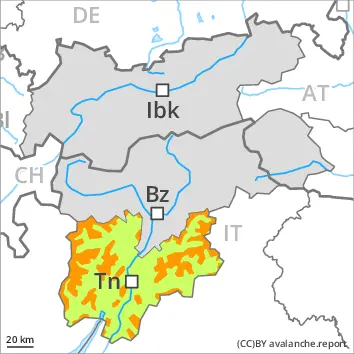
Low avalanche danger will prevail. Fresh wind slabs require caution.
Individual avalanche prone locations for dry avalanches are to be found in particular on very steep shady slopes above approximately 2200 m and adjacent to ridgelines. They are rather rare and are clearly recognisable to the trained eye.
Apart from the danger of being buried, restraint should be exercised as well in view of the danger of avalanches sweeping people along and giving rise to falls.
Snowpack
The small wind slabs of Thursday are bonding only slowly with the old snowpack on very steep shady slopes above approximately 2200 m. The old snowpack consists of faceted crystals.
The snowpack will be generally subject to considerable local variations. Only a small amount of snow is lying for the time of year in all altitude zones.
Tendency
Slight increase in danger as a consequence of the new snow. The avalanche prone locations are to be found on very steep shady slopes above approximately 2200 m.