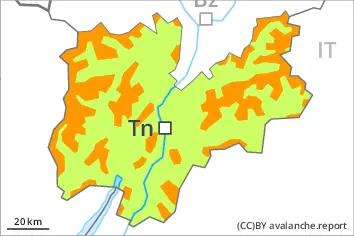
Danger level
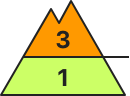 | treeline |
|  |
|  | ||||
| |
|  |
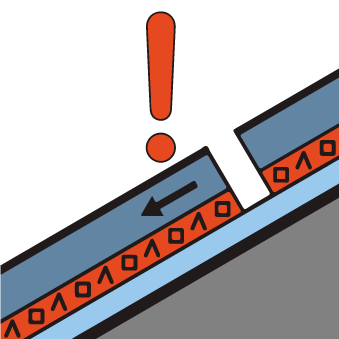


Weak layers in the old snowpack represent the main danger. In addition the wind slabs should be taken into account.
Over a wide area 10 to 20 cm of snow, and even more in some localities, fell on Saturday above approximately 1800 m. The wind was strong at times. The fresh and somewhat older wind slabs can be released easily or naturally. Avalanches can penetrate down to the ground and reach quite a large size, in particular in gullies and bowls, and behind abrupt changes in the terrain.
Weak layers in the old snowpack can be released even now by people. Caution is to be exercised in particular on very steep west, north and east facing slopes above the tree line, and on little used shady slopes. Whumpfing sounds and the formation of shooting cracks when stepping on the snowpack and fresh avalanches serve as an alarm indicating the danger.
The avalanche prone locations are quite prevalent and are barely recognisable, even to the trained eye. Maintaining distances between individuals and one-at-a-time descents are recommended. Experience and restraint are required.
Snowpack
dp.6: cold, loose snow and wind
dp.1: deep persistent weak layer
Distinct weak layers exist in the old snowpack. This applies especially on west, north and east facing slopes.
At high altitude the wind slabs have increased in size additionally in the last two days. The snowpack remains generally prone to triggering.
Some snow will fall in particular in the regions of the north exposed to the foehn wind.
Tendency
The avalanche danger will persist. Above the tree line a treacherous avalanche situation will prevail.