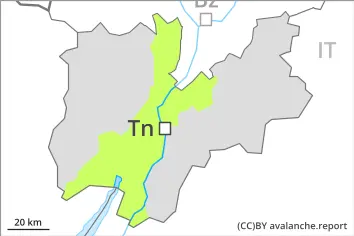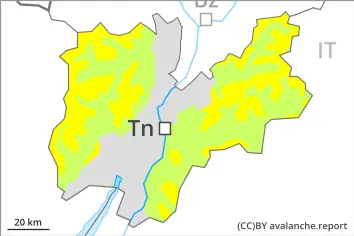
Danger level
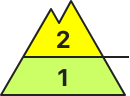 | 2000m |
|  |
|  | ||||
|  |
|  |

Weakly bonded old snow and wet snow require caution.
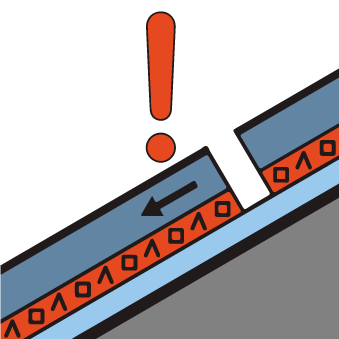
Weakly bonded old snow requires caution.
Avalanches can be released in the old snowpack, even by a single winter sport participant. They can in isolated cases release deeper layers of the snowpack and reach quite a large size. Avalanche prone locations are to be found especially above approximately 2000 m. These avalanche prone locations are to be found in particular in northwest to north to northeast facing aspects. Caution is to be exercised in particular on steep shady slopes, as well as at transitions from a shallow to a deep snowpack, when entering gullies and bowls for example.
Outgoing longwave radiation during the night was reduced. In the late morning the likelihood of slab avalanches being released will increase in particular on steep south and southwest facing slopes below the tree line.
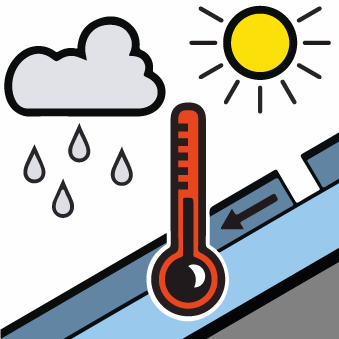
As a consequence of warming during the day individual mostly small wet loose snow avalanches are possible.
Snowpack
dp.1: deep persistent weak layer
dp.10: springtime scenario
Shady slopes: Distinct weak layers exist in the bottom section of the snowpack in particular on northwest, north and northeast facing slopes. This applies especially above approximately 2000 m.
Outgoing longwave radiation during the night was reduced. The surface of the snowpack is frozen, but not to a significant depth and will soften during the day. This applies in particular below approximately 2400 m.
The snowpack remains subject to considerable local variations over a wide area.
Tendency
Outgoing longwave radiation during the night was quite good over a wide area. The danger of moist and wet avalanches will increase during the day.