Wind slabs and weakly bonded old snow are to be assessed with care and prudence.
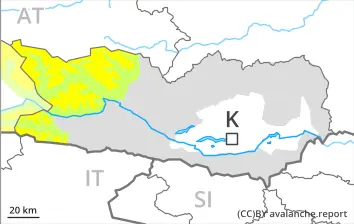
As a consequence of new snow and wind, mostly small wind slabs will form during the course of the night. Even single winter sport participants can release avalanches in some places. These can in some cases be triggered in near-surface layers and reach medium size. Caution is to be exercised in particular on very steep northwest, north and northeast facing slopes above approximately 2200 m, as well as on very steep west and east facing slopes above approximately 2500 m, in isolated cases also on very steep southeast, south and southwest facing slopes in high Alpine regions. Avalanche prone locations are to be found in gullies and bowls, and behind abrupt changes in the terrain and adjacent to ridgelines. Isolated whumpfing sounds can indicate the danger. Remotely triggered avalanches are possible in isolated cases.
Additionally in isolated cases avalanches can be triggered in near-ground layers. The avalanche prone locations are to be found in particular on very steep west, north and east facing slopes above approximately 2200 m. Such avalanche prone locations are rare but are barely recognisable. Especially transitions from a shallow to a deep snowpack are unfavourable. Avalanches can reach medium size.
Snowpack
dp.6: cold, loose snow and wind dp.7: snow-poor zones in snow-rich surrounding
Up to 10 cm of snow, and up to 15 cm in some localities, will fall during the night.
Wind slabs are lying on the unfavourable surface of an old snowpack, especially on very steep shady slopes above approximately 2200 m, also on very steep west and east facing slopes above approximately 2500 m, as well as on very steep southeast, south and southwest facing slopes at elevated altitudes.
Avalanche prone weak layers exist in the bottom section of the snowpack.
Steep sunny slopes: The weather conditions will give rise to moistening of the snowpack. In the event of solar radiation this applies in particular.
Tendency
Wind slabs and weakly bonded old snow require caution.
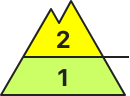
Danger level
1900m
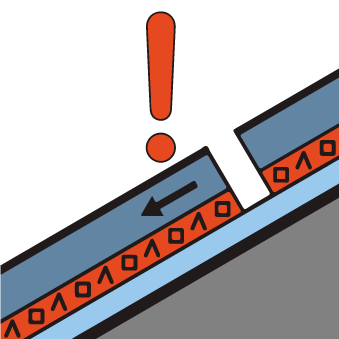
Avalanche Problem
Persistent weak layer
1900m
Increase in avalanche danger as a consequence of the snowfall. Weak layers in the upper part of the snowpack necessitate caution.
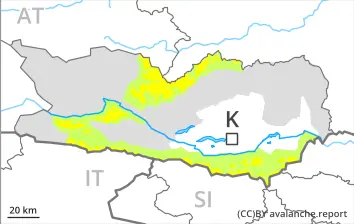
Even single winter sport participants can release avalanches in isolated cases. These can be triggered in near-surface layers. Avalanche prone locations are to be found in particular adjacent to ridgelines and in pass areas. In very isolated cases avalanches can also penetrate near-ground layers of the snowpack and reach medium size. Caution is to be exercised in particular on little used west, north and northeast facing slopes above approximately 1900 m. Especially transitions from a shallow to a deep snowpack are unfavourable.
Isolated whumpfing sounds can indicate the danger.
Snowpack
dp.7: snow-poor zones in snow-rich surrounding dp.1: deep persistent weak layer
In some localities up to 10 cm of snow will fall during the night.
The new snow and wind slabs will be deposited on the unfavourable surface of an old snowpack, especially on very steep west, north and northeast facing slopes above approximately 1900 m.
Large-grained weak layers exist in the bottom section of the snowpack.
Steep sunny slopes: The weather conditions will give rise to moistening of the snowpack. In the event of solar radiation this applies in particular.
Tendency
Weakly bonded old snow requires caution.
Danger level
1900m
Avalanche Problem
Persistent weak layer
1900m
Low avalanche danger will prevail.
Avalanches can be released in near-ground layers, in particular by large additional loads. This applies especially on northwest, north and northeast facing slopes above approximately 1900 m in steep rocky terrain. The avalanche prone locations are rare but are barely recognisable. In very isolated cases avalanches are medium-sized.
Snowpack
dp.1: deep persistent weak layer
Some snow will fall. Weak layers exist in the bottom section of the snowpack on northeast, north and northwest facing slopes. This applies in particular above approximately 1900 m. Steep sunny slopes: The weather conditions will give rise to moistening of the snowpack. In the event of solar radiation this applies in particular.