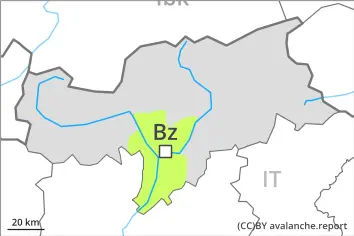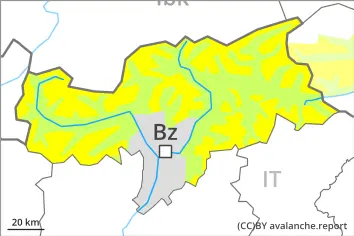
Danger level
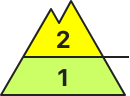 | 2200m |
|  |
|  | ||||
| |
| |
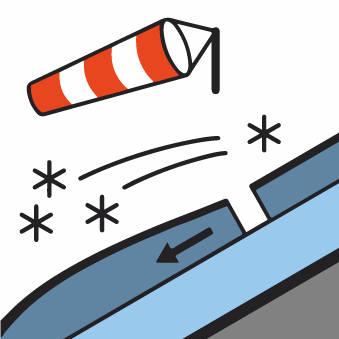
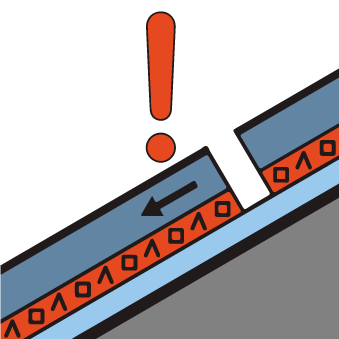

Wind slabs represent the main danger. Weakly bonded old snow requires caution.
The wind slabs can be released by a single winter sport participant in some cases on west to north to east facing aspects above approximately 2200 m. Caution is to be exercised in particular in gullies and bowls, and behind abrupt changes in the terrain. In some cases avalanches are medium-sized. Shooting cracks when stepping on the snowpack can indicate the danger.
Additionally in isolated cases avalanches can penetrate near-ground layers of the snowpack and reach large size, especially on west, north and east facing slopes above approximately 2200 m, and on south facing slopes at elevated altitudes.
Loose snow avalanches are possible, but they will be mostly small. In the event of solar radiation this applies in particular on extremely steep slopes.
Snowpack
dp.6: cold, loose snow and wind
dp.1: deep persistent weak layer
The gusty wind has transported the fresh and old snow significantly. In some cases the various wind slabs have bonded still only poorly together.
The old snowpack will be weakly bonded in some places, especially on west, north and east facing slopes above approximately 2200 m, and on south facing slopes at elevated altitudes.
Tendency
Slight increase in danger of wet avalanches as a consequence of warming.