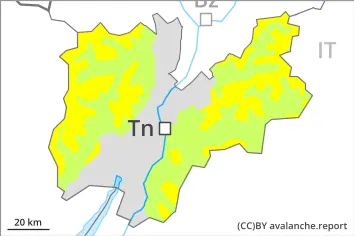
As the day progresses the likelihood of wet avalanches being released will increase quickly. Weakly bonded old snow requires caution.
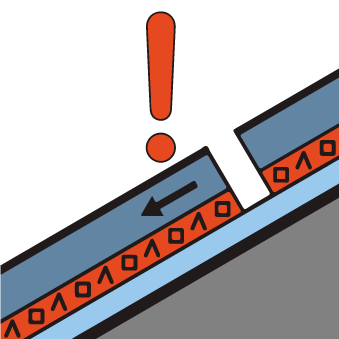
Dry avalanches can in some cases be released in the old snowpack, this applies even in case of a single winter sport participant in isolated cases. They can penetrate down to the ground and reach medium size. Caution is to be exercised in particular on very steep west, north and east facing slopes above approximately 2000 m, and on south facing slopes in high Alpine regions. Especially transitions from a shallow to a deep snowpack are unfavourable. Avalanche prone locations are to be found in particular in gullies and bowls, and behind abrupt changes in the terrain.
As the day progresses the likelihood of wet avalanches being released will increase especially on extremely steep east and west facing slopes. Wet avalanches can occur in particular in starting zones where previous releases have taken place. In some cases these are medium-sized and can be released easily also by a single winter sport participant. Backcountry tours should be started and concluded early.
Snowpack
dp.7: snow-poor zones in snow-rich surrounding dp.10: springtime scenario
Hard wind slabs are lying on top of a weakly bonded old snowpack in particular on west, north and east facing slopes at high altitude. The snowpack will be subject to considerable local variations.
Outgoing longwave radiation during the night will be quite good at times. The surface of the snowpack will freeze to form a strong crust. In steep terrain there is a danger of falling on the hard snow surface. On extremely steep sunny slopes the snowpack will soften rapidly. Sunshine and high temperatures will give rise as the day progresses to increasing and thorough wetting of the snowpack.
On steep sunny slopes at low and intermediate altitudes hardly any snow is lying.
Tendency
As a consequence of warming and solar radiation, the natural activity of moist and wet avalanches will gradually increase.
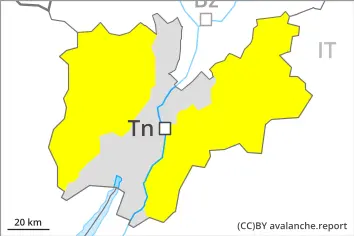
Danger level
Low danger will prevail.
Avalanches can in very isolated cases penetrate near-ground layers of the snowpack and reach medium size in isolated cases.
Snowpack
dp.10: springtime scenario
In steep terrain there is a danger of falling on the hard snow surface. The snowpack will be subject to considerable local variations. In particular on steep sunny slopes at low and intermediate altitudes hardly any snow is lying. The weather conditions will give rise to rapid moistening of the snowpack.