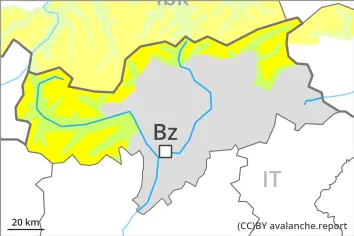
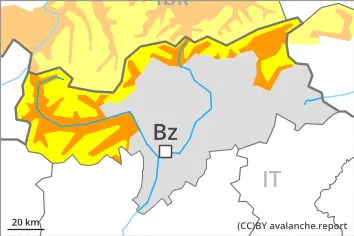
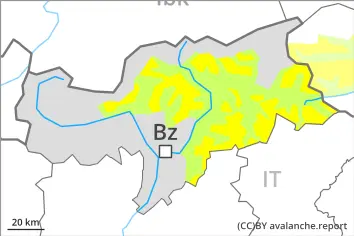
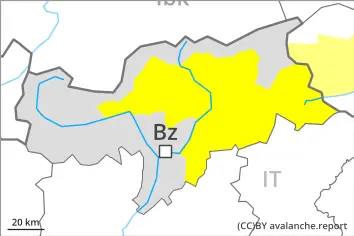
Increase in danger of wet avalanches in the course of the day.
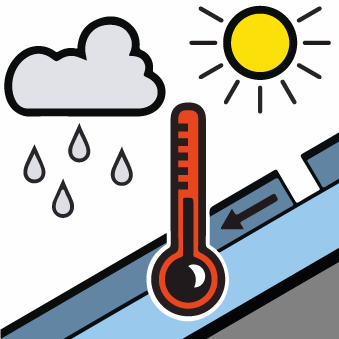
As the day progresses as a consequence of warming during the day and solar radiation there will be an appreciable increase in the danger of wet avalanches. Wet avalanches can in some places be released by a single winter sport participant. This applies on very steep shady slopes below approximately 2500 m, as well as on very steep sunny slopes at elevated altitudes. Natural avalanches are possible in the afternoon. Avalanches can be released in the weakly bonded old snow and reach large size in isolated cases.
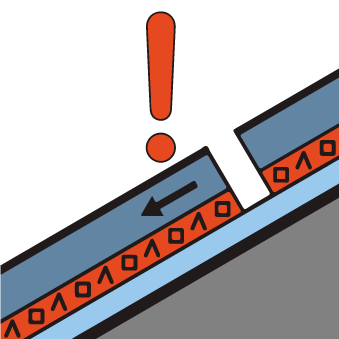
Dry avalanches can additionally be released, even by small loads in isolated cases, especially on very steep northwest, north and northeast facing slopes above approximately 2500 m. Especially transitions from a shallow to a deep snowpack are unfavourable. The avalanche prone locations are difficult to recognise.
Snowpack
dp.10: springtime scenario dp.1: deep persistent weak layer
The surface of the snowpack will freeze to form a strong crust and will soften during the day. Sunshine and high temperatures will give rise to increasing and thorough wetting of the snowpack below approximately 3000 m. Steep slopes: Faceted weak layers exist in the bottom section of the old snowpack at elevated altitudes.
Tendency
Outgoing longwave radiation during the night will be reduced. The backcountry touring conditions in the morning at elevated altitudes are generally favourable. As the day progresses as a consequence of warming during the day there will be an increase in the danger of wet avalanches. Some rain will fall in some regions.
EARLIER Danger level
2500m
Avalanche Problem
Persistent weak layer
2500m
LATER Danger level
3000m
Avalanche Problem
Wet snow
3000m
Persistent weak layer
2500m
Increase in danger of wet avalanches in the course of the day.
As the day progresses as a consequence of warming during the day and solar radiation there will be an increase in the danger of wet avalanches. Wet avalanches can in some places be released by a single winter sport participant. This applies on very steep shady slopes below approximately 2500 m, as well as on very steep sunny slopes at elevated altitudes. Small and medium-sized natural avalanches are possible in the afternoon.
Individual avalanche prone locations for dry avalanches are to be found on very steep shady slopes above approximately 2500 m. Especially transitions from a shallow to a deep snowpack are unfavourable. The avalanche prone locations are difficult to recognise.
Snowpack
dp.10: springtime scenario dp.1: deep persistent weak layer
The surface of the snowpack will freeze to form a strong crust and will soften during the day. Sunshine and high temperatures will give rise to gradual softening of the snowpack at intermediate and high altitudes. Steep slopes: Faceted weak layers exist in the bottom section of the old snowpack at elevated altitudes.
Tendency
Outgoing longwave radiation during the night will be reduced. The backcountry touring conditions in the morning at elevated altitudes are generally favourable. As the day progresses as a consequence of warming during the day there will be an increase in the danger of wet avalanches. Some rain will fall in some regions.
Danger level
2000m
Avalanche Problem
Wet snow
2000m
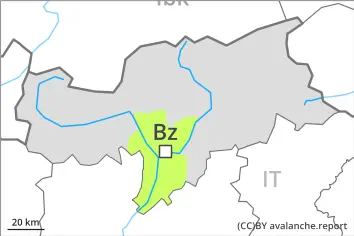
Wet snow requires caution.
Only isolated wet avalanches are possible. Caution is to be exercised on extremely steep shady slopes. Mostly avalanches are rather small.
Snowpack
dp.10: springtime scenario dp.1: deep persistent weak layer
The surface of the snowpack will freeze to form a strong crust and will soften during the day.
Tendency
Low avalanche danger will prevail. Wet snow requires caution.