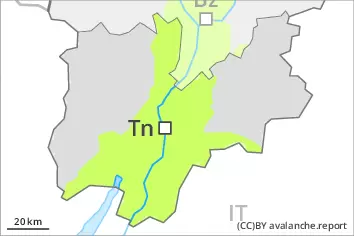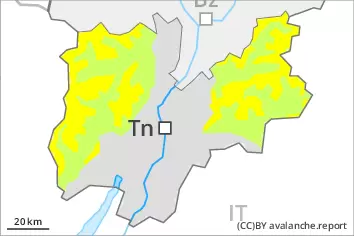
Danger level
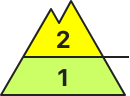 | 2200m |
|  |
|  | ||||
| |
|  |
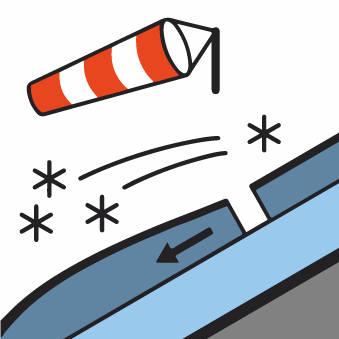
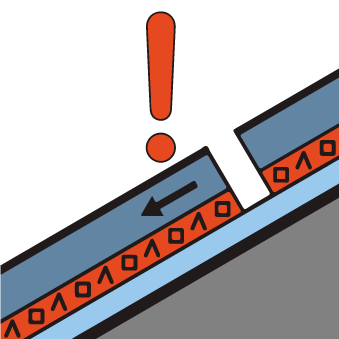

Wind slabs are to be evaluated with care and prudence.
The wind slabs are to be evaluated with care and prudence in all aspects above approximately 2200 m. In some cases avalanches are medium-sized and can be released even by a single winter sport participant. As a consequence of warming, the likelihood of moist loose snow avalanches being released will increase a little in particular on very steep sunny slopes at intermediate and high altitudes. Caution is to be exercised in particular adjacent to ridgelines and in gullies and bowls.
Weak layers in the old snowpack can be released in very isolated cases by individual winter sport participants in particular at transitions from a shallow to a deep snowpack. This applies in particular on very steep northwest, north and northeast facing slopes in particular above approximately 2400 m.
Snowpack
dp.6: cold, loose snow and wind
Wind slabs are lying on soft layers in particular on shady slopes at elevated altitudes. The fresh and somewhat older wind slabs are mostly easy to recognise but can in some cases be released easily especially at their margins.
Faceted weak layers exist in the centre of the snowpack in particular above approximately 2400 m. Weak layers in the old snowpack are difficult to recognise.
Tendency
The weather conditions will foster a gradual settling of the snow drift accumulations. As a consequence of warming, the likelihood of moist loose snow avalanches being released will increase in particular on very steep sunny slopes at intermediate and high altitudes.