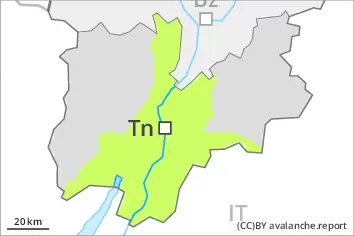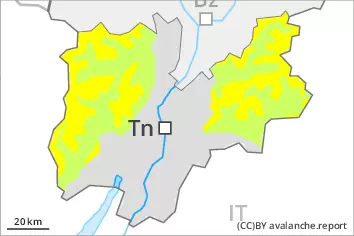
Danger level
 | treeline |
|  |
|  | ||||
|  |
| |

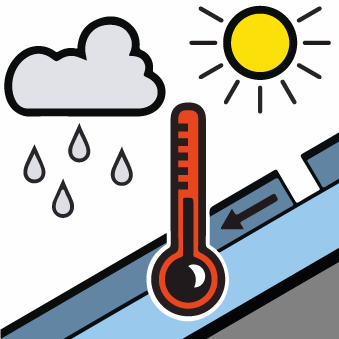

The fresh and older wind slabs represent the main danger. As the day progresses, moist snow slides are possible.
As a consequence of a strong wind from northwesterly directions, sometimes easily released wind slabs formed. In addition the older wind slabs must be taken into account. More recent wind slabs can be released even by a single winter sport participant.
The avalanche prone locations are to be found in particular adjacent to ridgelines and in gullies and bowls in all aspects. In addition in particular at the base of rock walls and behind abrupt changes in the terrain, further small and medium-sized natural avalanches are possible. As a consequence of warming during the day and solar radiation small and medium-sized wet loose snow avalanches are possible.
Snowpack
dp.6: cold, loose snow and wind
dp.10: springtime scenario
The wind has transported the loosely bonded old snow. The wind slabs are lying on soft layers in particular on steep shady slopes at high altitude. They are in some cases prone to triggering. The spring-like weather conditions gave rise to moistening of the snowpack below approximately 2700 m. The snowpack will be subject to considerable local variations. Early and late morning: The snowpack is wet and its surface has a melt-freeze crust that is strong in many cases.
Tendency
The avalanche danger will persist. Wet snow requires caution.