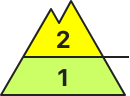
Increase in avalanche danger as a consequence of new snow and strong wind. Wind slabs represent the main danger.
As a consequence of new snow and a strong wind from northwesterly directions, wind slabs will form in the course of the day. These are mostly small. The fresh and older wind slabs can be released easily in many places.
The avalanche prone locations are to be found in particular on southwest to north to southeast facing aspects above approximately 2200 m and on steep south facing slopes above approximately 2400 m. Caution is to be exercised in particular adjacent to ridgelines, as well as in gullies and bowls, and behind abrupt changes in the terrain. Apart from the danger of being buried, restraint should be exercised as well in view of the danger of avalanches sweeping people along and giving rise to falls.
Snowpack
dp.6: cold, loose snow and wind
5 to 15 cm of snow will fall. The wind will be strong.
Fresh and older wind slabs are lying on top of a weakly bonded old snowpack. The old snowpack is faceted and its surface has a crust that is barely capable of bearing a load.
The snowpack will be generally subject to considerable local variations. A little snow is lying in all altitude zones.
Tendency
Further increase in avalanche danger as a consequence of new snow and strong wind.
Danger level
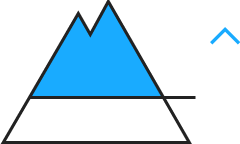
2200m
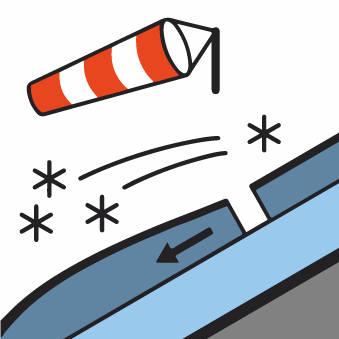
Avalanche Problem
Wind slab
2200m
Slight increase in avalanche danger as a consequence of new snow and strong wind. Wind slabs must be evaluated with care and prudence.
As a consequence of new snow and a strong wind from northwesterly directions, wind slabs will form in the course of the day. These are mostly small. The fresh and older wind slabs can be released easily in many places.
The avalanche prone locations are to be found in particular on southwest to north to southeast facing aspects above approximately 2200 m and on steep south facing slopes above approximately 2400 m. In high Alpine regions the avalanche prone locations are a little more prevalent and the danger is slightly greater. Caution is to be exercised in particular adjacent to ridgelines, as well as in gullies and bowls, and behind abrupt changes in the terrain. Apart from the danger of being buried, restraint should be exercised as well in view of the danger of avalanches sweeping people along and giving rise to falls.
Snowpack
dp.6: cold, loose snow and wind
Some snow will fall. The wind will be strong.
Fresh and older wind slabs are lying on top of a weakly bonded old snowpack. The old snowpack is faceted and its surface has a crust that is barely capable of bearing a load.
The snowpack will be generally subject to considerable local variations. A little snow is lying in all altitude zones.
Tendency
Further increase in avalanche danger as a consequence of new snow and strong wind.
Danger level
Wind slabs - Individual avalanche prone locations are to be found in particular on very steep shady slopes at elevated altitudes.
The somewhat older wind slabs can be released in isolated cases in particular on very steep shady slopes above approximately 2200 m. Caution is to be exercised adjacent to ridgelines and in gullies and bowls. Mostly avalanches are only small. Apart from the danger of being buried, restraint should be exercised in particular in view of the danger of avalanches sweeping people along and giving rise to falls.
Sunny slopes: In steep terrain there is a danger of falling on the hard snow surface.
Snowpack
Some snow will fall. The wind will be strong. The hard wind slabs are lying on soft layers at elevated altitudes.
The old snowpack is faceted and its surface has a crust that is barely capable of bearing a load. Very steep south facing slopes: The old snowpack is faceted and its surface has a crust that is strong in many cases.
The snowpack will be generally subject to considerable local variations. A little snow is lying in all altitude zones.
Tendency
Some snow will fall. Fresh wind slabs require caution.