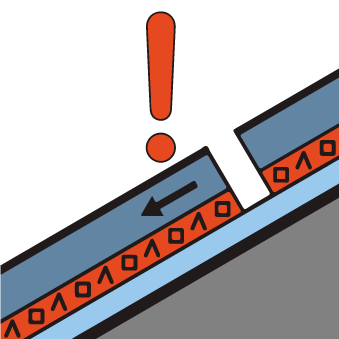
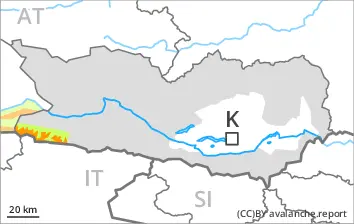
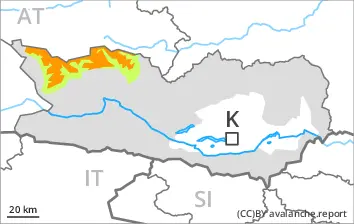
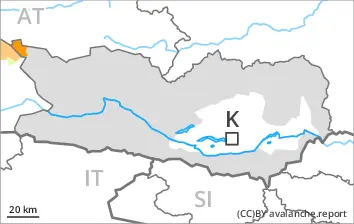
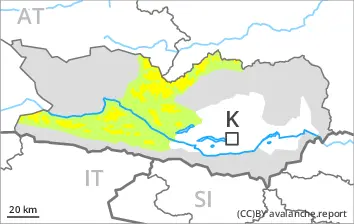
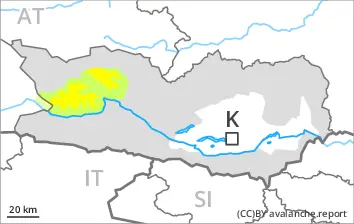
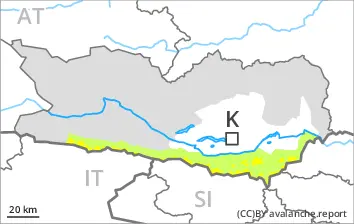
Wind slabs and weakly bonded old snow require caution.
Distinct weak layers in the old snowpack can be released easily by individual winter sport participants especially in little used terrain. Remotely triggered avalanches are possible. Steep, little used shady slopes are to be avoided as far as possible. Mostly avalanches are medium-sized. Caution is to be exercised in particular on steep west, north and east facing slopes above the tree line. The avalanche prone locations are difficult to recognise. Whumpfing sounds and the formation of shooting cracks when stepping on the snowpack and fresh avalanches serve as an alarm indicating the danger.
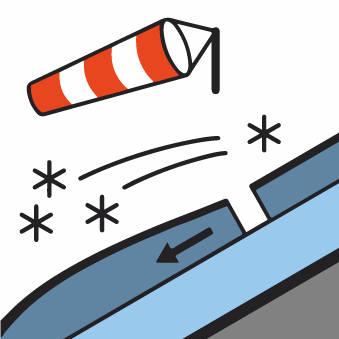
The rather small wind slabs of the last few days are in some cases still prone to triggering at elevated altitudes, in particular in gullies and bowls, and behind abrupt changes in the terrain above the tree line. They are easy for the trained eye to recognise.
The current avalanche situation calls for meticulous route selection.
Snowpack
dp.1: deep persistent weak layer dp.6: cold, loose snow and wind
The snowpack will be prone to triggering. Wind slabs are lying on surface hoar in some places. Faceted weak layers exist in the bottom section of the old snowpack. This applies in particular on west, north and east facing slopes above the tree line.
Tendency
Increase in avalanche danger as a consequence of the new snow. The weather report and anticipated change in the avalanche danger are uncertain.
Danger level
treeline
Avalanche Problem
Persistent weak layer
Treeline
Weakly bonded old snow represents the main danger.
Weak layers in the lower part of the snowpack can still be released in some places by individual winter sport participants. Caution is to be exercised in particular on steep west, north and east facing slopes above the tree line. The avalanche prone locations are difficult to recognise. Isolated whumpfing sounds can indicate the danger. Mostly avalanches are medium-sized.
In addition the small wind slabs of the last few days adjacent to ridgelines are prone to triggering in isolated cases still, especially on very steep shady slopes at elevated altitudes. They are clearly recognisable to the trained eye.
Snowpack
dp.1: deep persistent weak layer dp.8: surface hoar blanketed with snow
As a consequence of a strong wind from northwesterly directions, avalanche prone wind slabs formed especially in gullies and bowls. Somewhat older wind slabs are lying on surface hoar in some places.
Above approximately 1800 m: The snowpack will be prone to triggering. Distinct weak layers exist in the old snowpack. This applies in particular on west, north and east facing slopes.
Tendency
Increase in avalanche danger as a consequence of the new snow. The weather report and anticipated change in the avalanche danger are uncertain.
Danger level
2000m
Avalanche Problem
Persistent weak layer
2000m
Wind slab
2000m
Distinct weak layers in the old snowpack represent the main danger. Fresh wind slabs require caution.
Weak layers in the old snowpack can be released easily by individual winter sport participants. Caution is to be exercised in particular on steep west, north and east facing slopes above approximately 2000 m. The avalanche prone locations are difficult to recognise. Whumpfing sounds and the formation of shooting cracks when stepping on the snowpack and fresh avalanches serve as an alarm indicating the danger. Remotely triggered avalanches are possible. Mostly avalanches are medium-sized.
In addition the fresh wind slabs of the last few days in gullies and bowls, and behind abrupt changes in the terrain are prone to triggering in some cases still.
The avalanche conditions are unfavourable.
Snowpack
dp.1: deep persistent weak layer dp.8: surface hoar blanketed with snow
In some regions 10 to 20 cm of snow, and even more in some localities, has fallen since Sunday. The wind was strong at times.
The snowpack will be prone to triggering. Wind slabs are lying on surface hoar in some places. Faceted weak layers exist in the bottom section of the old snowpack. This applies in particular on west, north and east facing slopes above approximately 2000 m.
Tendency
Increase in avalanche danger as a consequence of the new snow. The weather report and anticipated change in the avalanche danger are uncertain.
Danger level
treeline
Avalanche Problem
Persistent weak layer
Treeline
Wind slab
Treeline
Distinct weak layers in the old snowpack represent the main danger. Fresh wind slabs require caution.
Weak layers in the old snowpack can be released very easily especially in little used terrain. Caution is to be exercised in particular on steep west, north and east facing slopes above the tree line. The avalanche prone locations are difficult to recognise. Whumpfing sounds and the formation of shooting cracks when stepping on the snowpack and fresh avalanches serve as an alarm indicating the danger. Remotely triggered avalanches are possible. Mostly avalanches are medium-sized.
In addition the fresh wind slabs of the last few days in gullies and bowls, and behind abrupt changes in the terrain are prone to triggering in some cases still. Such avalanche prone locations are to be found on north, east and southeast facing slopes above the tree line. Individual avalanche prone locations are to be found in areas close to the tree line.
Restraint is advisable.
Snowpack
dp.1: deep persistent weak layer dp.8: surface hoar blanketed with snow
In some regions 10 to 20 cm of snow, and even more in some localities, has fallen since Sunday. The wind was strong at times.
The snowpack will be prone to triggering. Wind slabs are lying on surface hoar in some places. Faceted weak layers exist in the bottom section of the old snowpack. This applies in particular on west, north and east facing slopes above the tree line.
Tendency
Weak layers in the old snowpack represent the main danger.
Thursday: The weather report and anticipated change in the avalanche danger are uncertain. In the north strong foehn wind from the south. In some regions snowfall.
Danger level
1800m
Avalanche Problem
Persistent weak layer
1800m
Wind slab
1900m
Wind slabs are lying on top of a weakly bonded old snowpack.
Avalanches can be triggered in the faceted old snow and reach medium size. This applies in case of a single winter sport participant. Caution is to be exercised in particular on northwest, north and east facing slopes above approximately 1800 m. The number and size of avalanche prone locations will increase with altitude. In addition the fresh wind slabs in gullies and bowls, and behind abrupt changes in the terrain are prone to triggering.
Snowpack
dp.1: deep persistent weak layer dp.6: cold, loose snow and wind
Some snow has fallen in some regions. The sometimes strong wind has transported the new snow. As a consequence of a strong to storm force wind from northwesterly directions, hard wind slabs formed in the course of the day. These are lying on surface hoar in some places in particular on northwest to north to southeast facing aspects above approximately 1900 m. Distinct weak layers exist in the old snowpack in particular on west, north and east facing slopes.
Tendency
Increase in avalanche danger as a consequence of the new snow. The weather report and anticipated change in the avalanche danger are uncertain.
Danger level
2000m
Avalanche Problem
Persistent weak layer
2000m
Wind slab
2200m
Weak layers in the old snowpack necessitate caution. Wind slabs require caution.
Avalanches can be released in the weakly bonded old snow by a single winter sport participant. Caution is to be exercised in particular on steep west, north and east facing slopes above approximately 2000 m. Mostly avalanches are medium-sized. Isolated whumpfing sounds can indicate the danger.
As a consequence of a moderate to strong wind, avalanche prone wind slabs formed in particular adjacent to ridgelines and in gullies and bowls. These can be released by a single winter sport participant, but they will be small in most cases. This applies in particular above approximately 2200 m.
The number and size of avalanche prone locations will increase with altitude.
Snowpack
dp.1: deep persistent weak layer dp.6: cold, loose snow and wind
Some snow has fallen. As a consequence of a moderate to strong wind from northerly directions, hard wind slabs formed. The wind slabs are lying on surface hoar in some places above approximately 2200 m.
Above approximately 2000 m: The snowpack will be prone to triggering. Distinct weak layers exist in the old snowpack. This applies in particular on west, north and east facing slopes.
Tendency
Increase in avalanche danger as a consequence of the new snow. The weather report and anticipated change in the avalanche danger are uncertain.
Danger level
1800m
Avalanche Problem
Persistent weak layer
1800m
Wind slabs are lying on top of a weakly bonded old snowpack.
In particular on wind-loaded slopes avalanches can be triggered in the faceted old snow and reach medium size. This applies even in case of a single winter sport participant in some cases. Caution is to be exercised in particular on west, north and east facing slopes above approximately 1800 m. The number and size of avalanche prone locations will increase with altitude.
Snowpack
dp.1: deep persistent weak layer dp.6: cold, loose snow and wind
Over a wide area 10 cm of snow has fallen above approximately 1500 m. As a consequence of a moderate to strong wind from northerly directions, wind slabs formed. These are lying on top of a weakly bonded old snowpack in particular on west to north to east facing aspects above approximately 1800 m.
Tendency
Increase in avalanche danger as a consequence of the new snow. The weather report and anticipated change in the avalanche danger are uncertain.
Danger level
1900m
Avalanche Problem
Persistent weak layer
1900m
Individual avalanche prone locations are to be found on steep shady slopes at elevated altitudes.
Avalanches can be released, mostly by large additional loads. This applies in particular on northwest, north and east facing slopes at elevated altitudes. Avalanches are rather small.
Snowpack
dp.1: deep persistent weak layer
A little snow is lying.
The snowpack will be unfavourable at elevated altitudes. Distinct weak layers exist in the old snowpack. This applies in particular on northwest, north and east facing slopes at elevated altitudes.