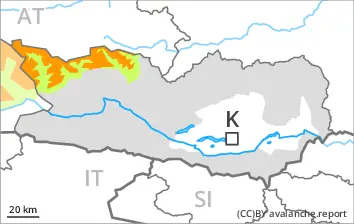
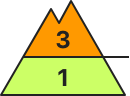
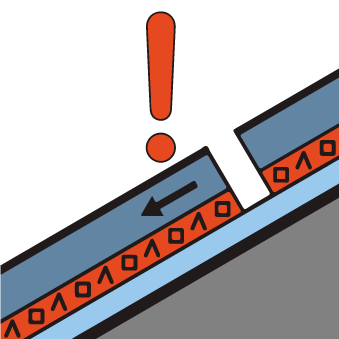
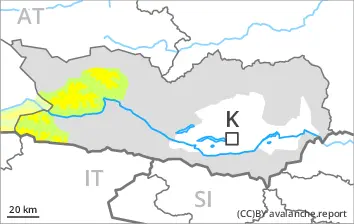
Weakly bonded old snow represents the main danger.
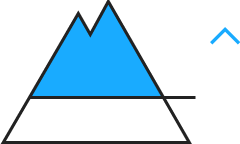
Avalanches can be released in the old snowpack and reach large size. This applies even in case of a single winter sport participant. The avalanche prone locations are to be found especially on west, north and east facing slopes above approximately 2000 m and in all aspects at elevated altitudes. Caution is to be exercised in particular at transitions from a shallow to a deep snowpack. Whumpfing sounds can indicate the danger. Remotely triggered avalanches are possible. In their paths avalanches can entrain the wet snow. This extends the avalanche runout distances.
Outgoing longwave radiation during the night will be severely restricted. Individual small and, in isolated cases, medium-sized wet avalanches are possible below approximately 2200 m.
Snowpack
dp.1: deep persistent weak layer dp.10: springtime scenario
Shady slopes: Distinct weak layers exist in the old snowpack in particular on west, north and east facing slopes.
The surface of the snowpack will only just freeze. The weather conditions gave rise to thorough wetting of the snowpack below approximately 2200 m.
Tendency
Weakly bonded old snow requires caution. Single winter sport participants can release avalanches as before.
Slight increase in danger of wet avalanches as a consequence of warming during the day and solar radiation.
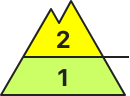
Danger level
2000m
Avalanche Problem
Persistent weak layer
2000m
Weakly bonded old snow requires caution.
Avalanches can in some cases be released in the old snowpack and reach quite a large size on west, north and east facing slopes. This applies even in case of a single winter sport participant in some cases. The avalanche prone locations are to be found in particular above approximately 2000 m. Caution is to be exercised in particular at transitions from a shallow to a deep snowpack, when entering gullies and bowls for example. Such avalanche prone locations are barely recognisable for beginners. In little used backcountry terrain the likelihood of avalanches is higher.
Outgoing longwave radiation during the night will be reduced. Individual mostly small wet avalanches are possible below approximately 2200 m.
Snowpack
dp.1: deep persistent weak layer dp.10: springtime scenario
Shady slopes: Distinct weak layers exist in the old snowpack in particular on west, north and east facing slopes. This applies especially above approximately 2000 m.
The surface of the snowpack will only just freeze. The weather conditions gave rise to thorough wetting of the snowpack below approximately 2200 m.
Tendency
Weakly bonded old snow requires caution. Slight increase in danger of wet avalanches as a consequence of warming during the day and solar radiation.
Danger level
1900m
Avalanche Problem
Persistent weak layer
1900m
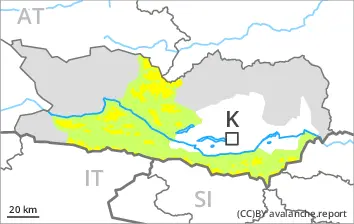
Individual avalanche prone locations are to be found in steep terrain at elevated altitudes.
In very isolated cases avalanches can be released in the old snowpack and reach medium size. This applies even in case of a single winter sport participant in isolated cases, especially at elevated altitudes on northwest, north and northeast facing slopes.
Outgoing longwave radiation during the night will be reduced. Only isolated mostly small wet avalanches are possible below approximately 2000 m.
Snowpack
dp.1: deep persistent weak layer dp.10: springtime scenario
The surface of the snowpack will freeze very little. The weather conditions gave rise to thorough wetting of the snowpack.
Shady slopes: Distinct weak layers exist in the old snowpack on west, north and east facing slopes. This applies especially at elevated altitudes.
Tendency
Slight increase in danger of wet avalanches as a consequence of warming during the day and solar radiation.
Danger level
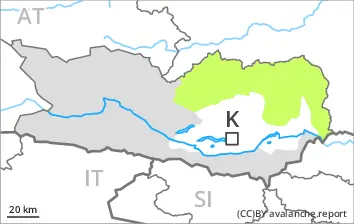
Low avalanche danger will prevail.
Avalanches are no longer likely to occur. Very isolated avalanche prone locations are to be found on very steep shady slopes at elevated altitudes.
Snowpack
dp.10: springtime scenario
Outgoing longwave radiation during the night will be reduced. The weather conditions gave rise to thorough wetting of the snowpack.
Individual weak layers exist in the old snowpack on northwest, north and northeast facing slopes.