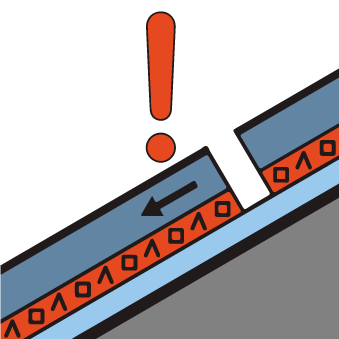
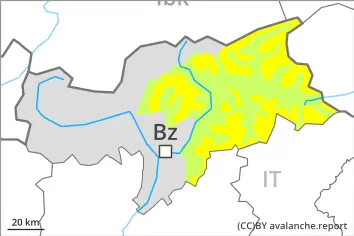
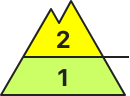
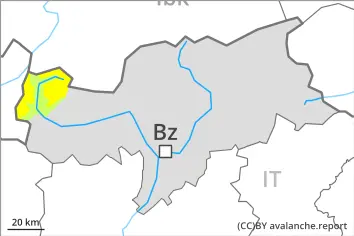
Wind slabs and weakly bonded old snow require caution.
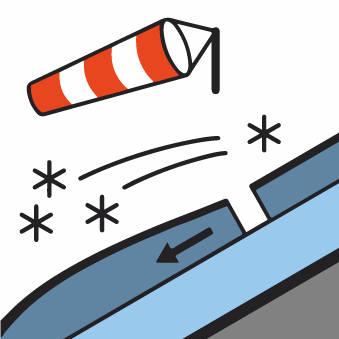
As a consequence of the sometimes storm force wind the wind slabs will increase in size moderately. The fresh wind slabs can in many places be released, even by a single winter sport participant and reach medium size. Avalanches can in isolated cases penetrate near-ground layers of the snowpack and reach large size. The avalanche prone locations are to be found in particular on very steep northwest, north and southeast facing slopes above approximately 2000 m. Caution is to be exercised in particular in gullies and bowls, and behind abrupt changes in the terrain above approximately 2000 m. The prevalence of avalanche prone locations and likelihood of triggering will increase with altitude. Whumpfing sounds and the formation of shooting cracks when stepping on the snowpack can indicate the danger.
In addition small and, in isolated cases, medium-sized moist loose snow avalanches are possible, in the event of solar radiation in particular on extremely steep slopes.
Snowpack
dp.6: cold, loose snow and wind dp.1: deep persistent weak layer
As a consequence of a strong to storm force wind from northerly directions, further wind slabs will form in gullies and bowls and behind abrupt changes in the terrain. They will be deposited on soft layers.
Avalanche prone weak layers exist in the bottom section of the snowpack on northwest, north and east facing slopes. This applies above approximately 2000 m.
Below approximately 2000 m and steep sunny slopes: The surface of the snowpack will soften during the day. The old snowpack will be moist.
Tendency
Wind slabs and weakly bonded old snow require caution.
As a consequence of the sometimes storm force wind the wind slabs will increase in size moderately. The fresh wind slabs can in some cases be released by a single winter sport participant. Mostly avalanches are rather small. Avalanches can in isolated cases be triggered in near-ground layers and reach medium size. The avalanche prone locations are to be found in particular on very steep northwest, north and southeast facing slopes above approximately 2200 m. Caution is to be exercised in particular in gullies and bowls, and behind abrupt changes in the terrain at transitions from a shallow to a deep snowpack. In the regions exposed to heavier precipitation the avalanche prone locations are more prevalent and larger.
In addition mostly small moist loose snow avalanches are possible, in the event of solar radiation in particular on extremely steep slopes.
Snowpack
dp.6: cold, loose snow and wind dp.7: snow-poor zones in snow-rich surrounding
The wind will be strong to storm force at times. At elevated altitudes rather small wind slabs will form. They will be deposited on the unfavourable surface of an old snowpack in particular on near-ridge shady slopes at elevated altitudes. The wind slabs of the last few days have settled a little. Avalanche prone weak layers exist in the bottom section of the snowpack on northwest, north and east facing slopes. This applies above approximately 2200 m.
Below approximately 2200 m and steep sunny slopes: The surface of the snowpack will soften during the day. The old snowpack will be moist.
Tendency
Wind slabs and weakly bonded old snow require caution.
As a consequence of the sometimes storm force wind the wind slabs will increase in size moderately. The fresh wind slabs can in some cases be released by a single winter sport participant, but they will be small in most cases. Avalanches can in isolated cases penetrate near-ground layers of the snowpack and reach large size. The avalanche prone locations are to be found in particular on very steep northwest, north and southeast facing slopes above approximately 2200 m. Caution is to be exercised in particular in gullies and bowls, and behind abrupt changes in the terrain at transitions from a shallow to a deep snowpack. The prevalence of avalanche prone locations and likelihood of triggering will increase with altitude.
In addition mostly small moist loose snow avalanches are possible, in the event of solar radiation in particular on extremely steep slopes.
Snowpack
dp.6: cold, loose snow and wind dp.7: snow-poor zones in snow-rich surrounding
The wind will be strong to storm force at times. At elevated altitudes rather small wind slabs will form. They will be deposited on the unfavourable surface of an old snowpack in particular on near-ridge shady slopes at elevated altitudes. The mostly small wind slabs of the last few days have settled a little. Avalanche prone weak layers exist in the bottom section of the snowpack on northwest, north and east facing slopes. This applies above approximately 2200 m.
Below approximately 2200 m and steep sunny slopes: The surface of the snowpack will soften during the day. The old snowpack will be moist.
Tendency
Wind slabs and weakly bonded old snow require caution.
Danger level
Low avalanche danger will prevail.
On extremely steep slopes small moist and wet snow slides are possible, in the event of solar radiation in particular. Avalanches can be released, in particular by large loads, but they will be small in most cases. Individual avalanche prone locations are to be found on steep shady slopes at high altitude.
Snowpack
dp.10: springtime scenario
Shady slopes: Isolated avalanche prone weak layers exist in the old snowpack in particular on northwest, north and northeast facing slopes.
Sunny slopes: The old snowpack will be moist. The weather conditions will give rise to thorough wetting of the snowpack at low and intermediate altitudes.