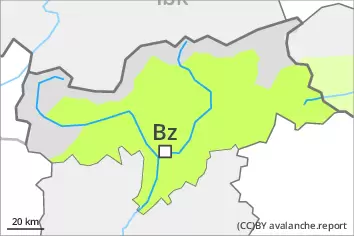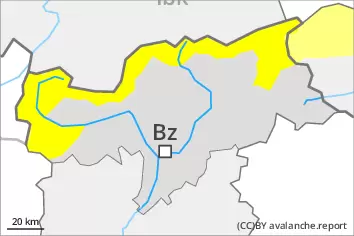
Danger level
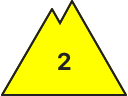 | 2200m |
|  |
|  | ||||
|  |
|  |
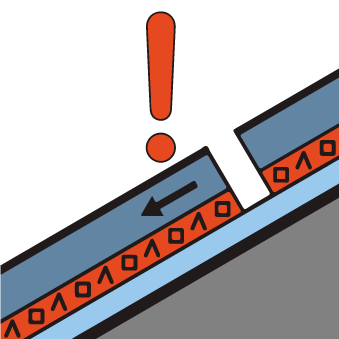

Weakly bonded old snow and wet snow require caution.
Weak layers in the old snowpack can still be released in some places by individual winter sport participants, especially at transitions from a shallow to a deep snowpack, when entering gullies and bowls for example, as well as in little used backcountry terrain. Caution is to be exercised on steep, little used shady slopes. These avalanche prone locations are rare but are difficult to recognise. Avalanches are medium-sized.
A partly overcast night: Outgoing longwave radiation during the night will be reduced in some case. As a consequence of warming during the day and solar radiation small and, in isolated cases, medium-sized wet and gliding avalanches are possible below approximately 2400 m. This applies in particular on extremely steep sunny slopes, as well as on steep, rather lightly snow-covered shady slopes below approximately 1800 m.
Backcountry tours should be concluded timely.
Snowpack
dp.1: deep persistent weak layer
dp.10: springtime scenario
The snowpack will be quite well bonded. Isolated avalanche prone weak layers exist in the bottom section of the snowpack, especially on shady slopes above approximately 2200 m.
The surface of the snowpack will freeze to form a strong crust only at high altitudes and will already be soft in the early morning. Sunshine and high temperatures will give rise as the day progresses to gradual softening of the snowpack. This applies especially on sunny slopes below approximately 2400 m, as well as on steep, rather lightly snow-covered shady slopes below approximately 1800 m.
In steep terrain there is a danger of falling on the hard snow surface. The snowpack will be subject to considerable local variations above the tree line. At low and intermediate altitudes less snow than usual is lying.
Tendency
Decrease in danger of wet avalanches as the temperature drops.