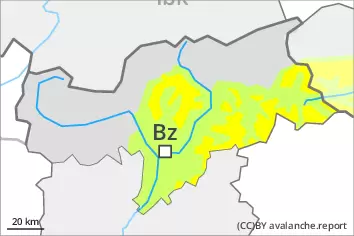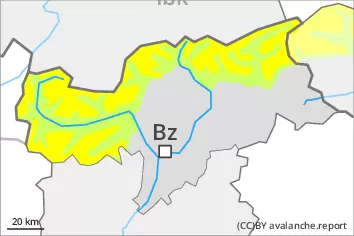
Danger level
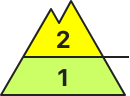 | 2400m |
|  |
|  | ||||
| |
|  |

Wind slabs and weakly bonded old snow require caution.
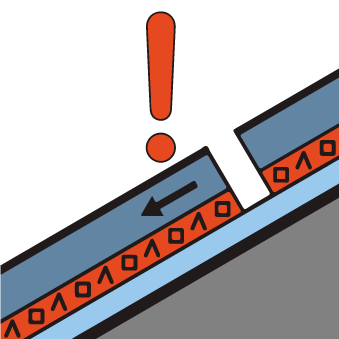
Weak layers in the old snowpack can be released especially by large additional loads at transitions from a shallow to a deep snowpack, when entering gullies and bowls for example. This applies on very steep slopes above approximately 2400 m. Avalanches can reach large size in isolated cases.
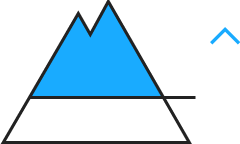
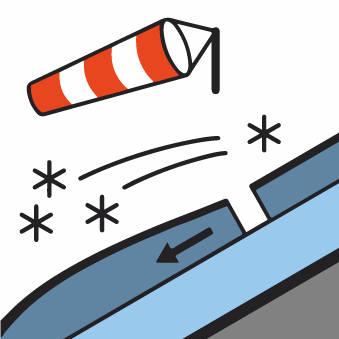
The no longer entirely fresh wind slabs are in some cases still prone to triggering in particular on northwest to north to east facing aspects above approximately 2400 m. Caution is to be exercised in particular adjacent to ridgelines.
On steep grassy slopes more small and, in isolated cases, medium-sized gliding avalanches are possible. This applies in particular in the regions with a lot of snow.
Snowpack
dp.7: snow-poor zones in snow-rich surrounding
dp.6: cold, loose snow and wind
Faceted weak layers exist in the centre of the snowpack in particular above approximately 2400 m. The fresh and somewhat older wind slabs are lying on soft layers in particular on shady slopes at elevated altitudes. The new snow and wind slabs are lying on a crust below approximately 2600 m.
Towards its base, the snowpack is moist, in particular below approximately 2400 m.
Tendency
The avalanche danger will persist.